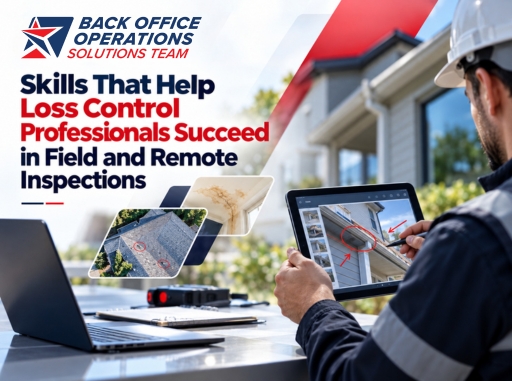
Two inspectors can walk into the same warehouse and walk out with completely different results. One leaves vague notes and blurry photos behind. The other delivers clear findings, useful documentation, and recommendations an underwriter can act on. Same building. Same risks, but different outcomes. What makes the difference? Skill, not luck. And that is good news if you are considering a loss control career, because the skills that set great inspectors apart can be learned, practiced, and strengthened over time.
Key Takeaways
- Observation and writing matter as much as technical knowledge.
- Field and remote inspections now sit side by side.
- Tech comfort helps any loss control career grow faster.
- Clear, defensible reports build trust with underwriters.
- Free training can shorten your path.
What Does a Loss Control Career Include?
A loss control professional inspects commercial properties, spots hazards, and documents what insurers need to understand a risk. Underwriters use that work to decide how to price and manage a policy.
Titles change from one employer to the next. You may see a loss control specialist, consultant, or inspector. The core work stays the same. Look closely, think clearly, and report accurately.
If you are scanning loss control inspector jobs, you will notice something else. Some postings now mention remote desk reviews next to on-site visits. The role is widening.
Why a Loss Control Career Attracts Career Changers
Insurance inspection careers welcome people from many backgrounds. Boost USA looks for safety leaders, risk managers, and compliance professionals from manufacturing, construction, transportation, and energy. Fire safety experts, military veterans, law enforcement professionals, and insurance veterans also fit well.
The flexibility helps too. At Boost USA, inspectors choose their schedule, location, and workload. That control makes a loss control career attractive to people who want independence without losing purpose.
Essential Field Inspection Skills for Loss Control Professionals
Field work rewards sharp senses and steady habits. Build these first:
- Observation. Notice the stained ceiling tile or the propped fire door.
- Hazard recognition. Know what risk looks like in a bakery, a machine shop, or a distribution center.
- Time management. Plan routes, set visit lengths, and finish on schedule.
- Physical readiness. Climbing ladders and walking sites are part of the job.
- Customer service. Business owners are often nervous. A calm, respectful tone opens doors.
Essential Remote Inspection Skills for Loss Control Professionals
Remote work changes the method, not the standard. Carriers still need accurate facts. They gather them differently.
Boost USA reports 25%+ savings on video-guided inspections and 50%+ on guided self-inspections. Savings like that explain why carriers keep adding remote options. They also raise the value of anyone who works well in this format.
Build these strengths:
- Clear direction. Guide the insured on camera, one step at a time.
- Visual judgment. Choose the angles that prove a point.
- Digital fluency. Stay comfortable with PC or Mac, Microsoft apps, and web-based reporting platforms.
- Patience. Some insureds need a second explanation. Give it calmly.
For wider context on safety-focused occupations, the U.S. Bureau of Labor Statistics Occupational Outlook Handbook offers useful workforce data.
Field vs. Remote Inspection Skills: Comparison
Skill area | Field inspection | Remote inspection |
Core strength | Direct observation | Guiding and questioning |
Documentation | Photos, notes, sketches | Video captures, screenshots, guided forms |
Communication | Face to face | Clear spoken and on screen directions |
Technology | Mobile and web reporting tools | Video tools and digital forms |
Biggest challenge | Travel and physical demands | Seeing only what the camera shows |
A loss control career today blends field inspection and remote inspection.
Why Writing Skills Matter in a Loss Control Career
The report is the product. Underwriters read it fast and act on it. Vague notes cost you credibility. Precise ones earn it.
Write like this:
- State the hazard plainly.
- Back it with a photo.
- Name the fix.
- Cut the filler.
Boost USA lists excellent written communication among its key inspector qualities. Strong writing is the fastest way to lift a loss control career. Risk inspection careers also reward curiosity. Ask why a hazard exists, not just where it sits.
Common Mistakes New Loss Control Inspectors Make
- Treating the visit as a checklist instead of an investigation.
- Skipping the photo that proves the finding.
- Writing recommendations that sound like opinions.
- Ignoring technology until the first deadline hits.
How to Build the Skills Needed for a Loss Control Career
Building a loss control career is easier with a plan.
- Match your background to the role. Safety, fire, compliance, and military experience all transfer.
- Learn the insurance basics—study commercial property and casualty lines.
- Practice writing findings. Describe hazards at places you visit, then tighten each note.
- Try both formats. Practice on-site observation and on-camera guidance.
- Consider credentials. CSP, OHST, ALCM, and ARM often appear as preferred, not required, on postings.
A loss control specialist who masters these steps stands out quickly.
How Boost USA Supports a Loss Control Career
Boost USA supports a loss control career at every stage.
- Free training. The Loss Control Learning Center offers free training for people entering or growing in the field.
- No placement fees. Insurance partners pay Boost USA. You keep 100% of your inspection earnings.
- Real support. Inspectors get an LMS, resource references, and responsive help.
- Smoother workflows. Territory manager support and guided self inspections cut coordination noise. AI powered QA and LC360 integration keep reports clean.
- Growing coverage. Active markets include Vermont, Chattanooga, San Jose, Salt Lake City, Tucson, and Long Island. More are coming.
Earning potential reaches $100K+ per year. It grows with experience and assignments.
Final Thoughts
Field or remote, strong inspectors share the same habits. They look closely, think clearly, and write with care. None of that is out of reach.
A loss control career rewards people who keep learning. Start with one skill this week. Practice it. Then add the next. Small, steady steps lead to a role where your judgment protects businesses and communities.
FAQs:
What skills are most important for a loss control career?
Strong observation, hazard recognition, communication, writing, time management, and technology skills are important for a successful loss control career. Inspectors also need to document findings clearly and provide practical recommendations.
Can you work remotely as a loss control inspector?
Yes. Some loss control work can be completed remotely through video guided inspections, guided self inspections, and desk reviews. Remote inspections still require strong communication, visual judgment, documentation, and technology skills.
Do you need insurance experience to become a loss control inspector?
Not always. Professionals with backgrounds in safety, fire protection, compliance, risk management, construction, manufacturing, transportation, and other related fields may have transferable skills for a loss control career.
What qualifications are needed to become a loss control inspector?
Requirements vary by employer and assignment. Relevant experience and knowledge of safety and risk management can be valuable, while credentials such as CSP, OHST, ALCM, and ARM may be preferred for some positions.
Is writing important for loss control inspectors?
Yes. Clear writing is essential because underwriters rely on inspection reports to understand risks and make informed decisions. Inspectors should describe hazards accurately, support findings with documentation, and provide clear recommendations.
How can I start a loss control career?
Start by building knowledge of insurance, commercial property risks, safety practices, and inspection reporting. Free training, practical experience, and familiarity with both field and remote inspection methods can help you prepare for loss control inspector opportunities.
Ready to Build Your Loss Control Career?
You already have skills that can transfer into loss control. Now, put them to work. Explore free training, see where your experience fits, and discover opportunities to build a flexible career in field and remote inspections. Become a Loss Control Inspector with Boost USA and take the next step toward a career where your expertise can make a real difference.