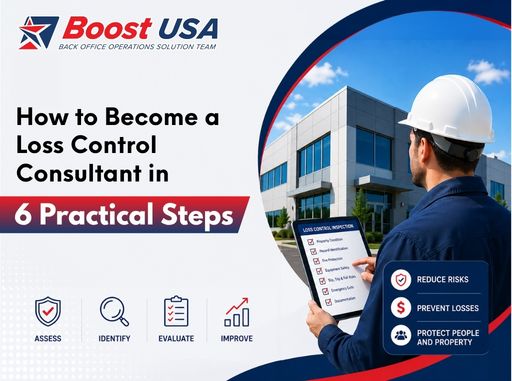
Most people who end up choosing loss control consulting as a career did not initially plan for it. They came from different backgrounds, such as insurance, safety, construction, or the military. However, at a certain point in time or another, they realized that their field experience was exactly what the inspection career world was looking for.
The path into loss control consulting is more accessible than it appears from the outside. However, it requires a deliberate sequence of steps. Here is the guide that clearly lays out those six steps. So, whether you choose to build this career from scratch or are transitioning from a related field, what follows is a practical roadmap and not a general overview.
What Does a Loss Control Consultant Actually Do?
Before mapping the path, you should be precise about the destination. A loss control consultant evaluates commercial properties and business operations on behalf of insurance carriers.
It is worth being precise about the destination. A loss control consultant evaluates commercial properties and business operations on behalf of insurance carriers, MGAs, and risk management firms. Their work involves conducting onsite inspections, identifying hazards, documenting findings accurately, and delivering reports that underwriters use to make binding decisions.
The quality of that work directly affects pricing, coverage terms, and claims exposure. A vague or incomplete inspection report creates the same downstream risk as a missed hazard. Here are the essential steps to becoming a loss control consultant.
Step 1: Build the Right Educational Foundation
The majority of employers in loss control expect a bachelor’s degree as a baseline. Degrees in occupational health and safety, engineering, environmental science, or risk management provide the most direct entry. Some consultants enter through business or physical science backgrounds and build on their professional development afterward.
The degree is less about the specific discipline and more about demonstrating the analytical foundation required to evaluate complex risk environments. If you are still in the planning stage, prioritize programs that include coursework in OSHA standards, risk assessment methodology, or property and casualty insurance.
Step 2: Gain Relevant Field Experience
No credential replaces direct field exposure. The inspection career track moves faster for candidates who have spent time in roles where hazard identification and site assessment were part of the daily routine.
Backgrounds that translate well into loss control consulting include construction project management, HVAC installation and systems, safety officer and EHS coordinator positions, insurance underwriting or claims, industrial hygiene, and fire protection services. Two to three years in any of these roles builds the observational skills and site familiarity that loss control consulting demands from day one.
Step 3: Earn a Recognized Loss Control Certification
A loss control certification is the clearest signal to carriers, MGAs, and independent inspection firms that you understand both the technical and professional standards of the work.
It also separates candidates in a competitive field, where credentials are used to quickly filter applicants.
The table below compares the three most relevant certifications for professionals entering or advancing in this field.
Certification | Issuing Body | Primary Focus | Best Entry Point |
ALCM | The Institutes | Loss control management | Field consultants and inspectors |
ARM | The Institutes | Risk management fundamentals | Insurance and underwriting professionals |
CRM | RIMS | Enterprise risk strategy | Senior risk management roles |
For most professionals beginning an inspection career, the Associate in Loss Control Management (ALCM) is the most direct starting point.
It is purpose built for loss control work, recognized across the carrier and MGA community. Also, it does not require years of prerequisites to pursue.
Step 4: Develop Your Core Inspection Competencies
The ALCM and related certifications establish the theoretical framework. Practical competency stems from developing specific inspection skills that carriers and clients rely on to generate accurate risk data.
OSHA Fluency Is Non Negotiable
The 1910 standard for general industry and the 1926 standard for construction are the most frequently applied regulatory references in commercial loss control work. Understanding how these standards translate into observable field conditions is foundational.
Beyond OSHA, effective loss control consultants develop working knowledge of fire protection systems and suppression requirements, roof condition assessment, fleet and auto exposure evaluation, electrical hazard identification, and slip, trip, and fall documentation.
The ability to convert what you observe onsite into a clear, defensible written report is what distinguishes a competent inspector from one that carriers actively seek out.
Step 5: Choose an Industry Specialization
Loss control is not a single discipline. The risk profile of a hospitality account looks nothing like that of a structural steel fabricator.
Consultants who specialize in one or two verticals become significantly more valuable to carriers and firms working in those lines.
High demand specializations in the current market include commercial construction and contractors, habitational and residential portfolios, healthcare and long term care, transportation and fleet operations, and manufacturing.
Choosing a specialization early accelerates your credibility, sharpens your inspection skills in context, and typically commands stronger per inspection rates.
Step 6: Connect With the Insurance Ecosystem
The inspection career market is relationship driven. Most loss control consulting opportunities are not posted publicly. They move through networks within the carrier, MGA, and independent inspection firm communities.
Build active connections with commercial underwriters, territory managers at regional carriers, independent insurance agencies, and third party administration firms.
RIMS chapter events, TMPAA conferences, and NAMIC conventions are where practitioners and hiring decision makers interact directly. Consistent, visible participation in these spaces is how loss control consultants build a sustainable pipeline of work.
FAQs on How to Become a Loss Control Consultant
What qualifications are required to become a Loss Control Consultant?
Most Loss Control Consultants have a bachelor’s degree in safety management, engineering, occupational health, or a related field. Many employers also prefer certifications like OSHA training, CSP, ARM, or CPCU. Experience in risk assessment, insurance, or workplace safety is highly valued.
What skills are essential for a successful Loss Control Consultant career?
Strong analytical, communication, and problem solving skills are essential. A Loss Control Consultant must identify workplace risks, develop safety recommendations, and clearly explain findings to clients. Knowledge of regulations, inspections, and risk management practices is also important.
How long does it take to become a Loss Control Consultant?
It typically takes around 4 to 6 years, including earning a degree and gaining industry experience. Some professionals enter the field faster through safety certifications and hands-on training. Advanced certifications may require additional years of work experience.
What industries hire a Loss Control Consultant the most?
Insurance companies are among the biggest employers of Loss Control Consultants. Other major industries include construction, manufacturing, healthcare, transportation, energy, and retail. Any industry focused on workplace safety and risk reduction may hire these professionals.
Ready to Build Your Inspection Career With the Right Support Behind You?
Boost USA works with insurance carriers, MGAs, and risk management firms to support every layer of the loss control operation, from Recruitment and Talent Sourcing for qualified inspectors to QA for Loss Control Reports. This ensures that the field data reaches underwriters accurately and on time.
If you are building your inspection career and want to connect with an operation that supports your growth, or if you are a carrier or MGA looking to strengthen your loss control program with qualified field professionals and streamlined back office infrastructure, contact Boost USA today. We are here to help you reach your goals easily.