
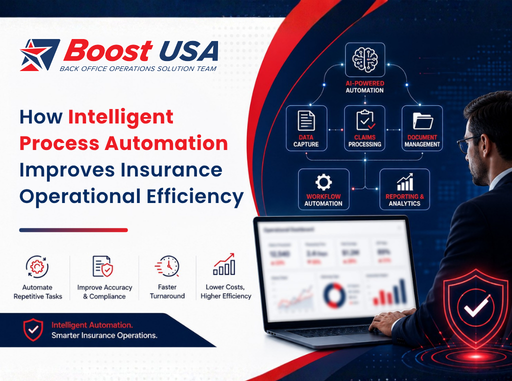
Insurance companies run on precision and speed. Yet many carriers, MGAs, and brokers still rely on manual data entry, email-based approvals, disconnected systems, and labour-intensive workflows. The result is an operational structure that quietly increases costs, slows service, and limits scalability. This is where Intelligent Process Automation (IPA) changes the equation.
Unlike traditional robotic process automation (RPA), which simply mimics repetitive human actions, IPA combines workflow automation with artificial intelligence technologies such as machine learning, optical character recognition (OCR), natural language processing, and decision engines. The goal is not just automation, but smarter and faster execution across high-volume insurance operations.
Why Insurance Companies Need Intelligent Process Automation
Insurers face extensive pressure because of several factors, such as operational costs, regulatory complexity, tighter labor markets and customer expectations that are shaped by fast digital experiences. Many internal processes remain highly manual.
According to McKinsey & Company Insurance 2030 research, up to 25% of insurance work activities are automatable using currently available technologies, and the percentage increases further when AI-enhanced automation tools are included.
For the insurers, automation is no longer an option. It is an operational edge that affects margins, efficiency, and customer retention as well.
The Hidden Labor Cost Problem in Insurance Operations
Labor is the biggest operating expense in insurance. However, much of that cost is buried inside support functions such as underwriting support, claims administration, policy servicing, compliance reporting and billing reconciliation.
These are process-driven tasks with defined rules and predictable outcomes. Yet they still consume thousands of hours of manual labour every month. Intelligent process automation reduces this dependency on repetitive labor and improves accuracy plus consistency too.
The greatest value comes from bridging the gap between expensive staff handling and software automation. That is where managed execution models and intelligent automation create measurable operational gains.
Where Intelligent Process Automation Delivers the Biggest Impact
Claims handling is one of the most labor-intensive areas in insurance that IPA systems can process. First notice of loss submissions across email, portals, PDFs, and phone transcripts, automatically extract structured data, validate coverage, and route claims to the correct adjuster or workflow.
What once required manual review now happens in seconds, improving both operational speed and the policyholder experience.
Policy Administration and Endorsements
Policy endorsements often create operational bottlenecks. Tasks such as updating coverage limits, adding vehicles, or changing named insured details require multiple manual steps.
Intelligent process automation handles rule-based steps automatically, routing exceptions to underwriters only when human judgment is required. This reduces turnaround time, lowers errors, and allows underwriting teams to focus on risk evaluation rather than administrative work.
Billing Reconciliation and Premium Accounting
Finance teams spend significant time matching payments, managing cancellations, reconciling premiums, and preparing reports. IPA automates these repetitive processes continuously. This reduces reconciliation errors and improves reporting accuracy.
Compliance Monitoring and Regulatory Reporting
Insurance companies operate in one of the most heavily regulated industries in the world. Intelligent process automation helps monitor transactions against compliance rules in real time, flag anomalies, and automatically assemble required reports.
This reduces regulatory risk while freeing compliance teams to focus on higher-value analysis and oversight.
Document Processing and Data Extraction
Insurance operations are document-heavy. Applications, certificates, loss runs, and claims documents all require data extraction and entry.
AI-powered OCR tools can extract information from unstructured documents and push it directly into core systems, eliminating manual rekeying and significantly reducing human error.
The Intelligent Insurance Automation Maturity Model
Most insurance businesses are still in the early stages of automation maturity.
Stage 1: Task Automation
Basic repetitive tasks, such as report generation or file transfers, are automated individually.
Stage 2: Workflow Integration
Automated processes are connected across systems such as claims platforms, CRMs, billing systems, and policy administration software.
Stage 3: Intelligent Decision Support
Machine learning models begin assisting with document classification, claims scoring, renewal predictions, and exception handling.
Stage 4: Continuous Optimization
Automation systems continuously generate operational insights that improve workflows, compliance monitoring, and strategic decision-making.
Most insurers currently operate between Stages 1 and 2, leaving substantial efficiency gains untapped.
Insurance Operations Before vs After Intelligent Process Automation
Insurance Workflow | Traditional Process | With Intelligent Process Automation | Business Impact |
Claims Intake and FNOL | Manual data entry and document review | Automated data extraction and claim routing | Faster claims processing and improved customer experience |
Policy Endorsements | Multiple manual approval steps | Rule based automated updates with exception handling | Reduced turnaround time and fewer errors |
Billing Reconciliation | Manual payment matching and reporting | Continuous automated reconciliation | Improved accuracy and lower administrative workload |
Compliance Reporting | Manual monitoring and report preparation | Real time compliance tracking and automated reporting | Reduced compliance risk and faster audits |
Document Processing | Staff manually rekey information from documents | AI powered OCR extracts and validates data automatically | Reduced human error and improved efficiency |
Customer Service Operations | Delayed responses during high volume periods | Automated workflows with scalable processing support | Faster response times and higher customer satisfaction |
Why Technology Alone Is Not Enough
Many insurance automation initiatives fail because businesses assume software alone will solve operational inefficiencies. In reality, technology only defines what is possible. Execution determines what gets delivered.
Semi-repetitive insurance workflows still require human oversight at the margins. Edge-case claims, data conflicts, and non-standard endorsements often require trained professionals working within structured processes.
This is why successful automation strategies combine technology with a managed execution model that includes supervised teams, documented SOPs, performance tracking, and operational accountability.
The Business Impact of Intelligent Process Automation
When intelligent process automation and disciplined execution work together, the outcomes are measurable across the business:
- Faster policyholder service and claims handling
- Lower administrative costs and improved combined ratios
- Reduced compliance risk through consistent execution
- Scalable operational capacity during peak periods
- Better data quality across underwriting, claims, and reporting systems
- Improved customer satisfaction through faster response times and fewer errors
These are not theoretical benefits. They directly impact profitability, retention, and long-term operational scalability.
Final Thoughts
Insurance companies can no longer afford operational inefficiencies hidden inside manual workflows and outdated processes. Intelligent process automation enables insurers to reduce costs, improve service delivery, strengthen compliance, and scale operations without sacrificing accuracy or customer experience.
However, technology alone is not enough. Real operational efficiency comes from combining automation with structured execution, trained professionals, and consistent oversight. Insurance organizations that modernize their workflows today will build a significant competitive advantage in speed, scalability, and long-term profitability.
Modernize Your Insurance Operations With Smarter Process Automation
Boost USA helps insurance businesses streamline workflow-driven operations through intelligent automation, structured support models, and operational efficiency solutions tailored for long-term scalability. If your insurance operations are still slowed down by repetitive manual processes, now is the time to modernize your systems, improve turnaround times, and unlock measurable business growth. Get in touch with us today!