
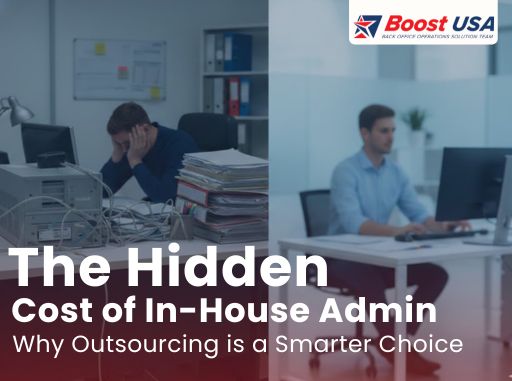
Every minute invested by your core team in administrative tasks is a minute stolen from your company’s growth. Yet, most companies hire large in-house administrative teams without realizing the hidden costs involved. Let us discuss why an in-house team is a waste of time, money, and resources and what makes outsourcing a smarter choice in this article.
The Price Tag Nobody Talks About
When you calculate the cost of keeping administrative functions in-house, salary is only a fraction of the total cost you incur per employee. Consider the real numbers: a full-time in-house administrative employee earning $45,000 annually actually costs your business between $60,000 and $75,000. This includes additional expenses such as payroll taxes, health insurance, retirement benefits, paid time off, and workers’ compensation.
There are further costs as well, such as office space, which can cost around $10,000 per employee annually, along with equipment, training, and software licenses. And this is not all. While your leadership team manages schedule conflicts, processes invoices, handles customer service tickets, and deals with several other administrative tasks, your competitors are innovating, marketing, and capturing market share. As a result, you are not just overspending on administrative work, you are also restricting your growth by relying on an in-house team.
Additionally, in-house teams typically work standard business hours, which creates hurdles when urgent tasks arise after official hours. Vacation days and sick leave often mean watching work pile up. Scaling also becomes difficult, as you cannot easily hire additional employees during peak seasons or reduce headcount when demand declines.
The Outsourcing Advantage: More Than Cost Savings
Smart businesses that stay ahead of the curve have embraced outsourcing because it transforms administrative work from a cost center into a competitive advantage. Strategic resource allocation is what separates market leaders from the rest.
Businesses that adopt offshore outsourcing for administrative functions gain access to a global talent pool of highly skilled professionals who cost 50–70% less than domestic hires. These professionals do more than just save money. Dedicated experts in back-office operations work around the clock to ensure your business never stops.
With IT support outsourcing, you no longer rely on a single generalist handling everything from password resets to cybersecurity. Instead, you gain access to an entire team of experienced professionals. Network issues are resolved by network engineers, security concerns are addressed by certified security professionals, and help desk tickets move through a tiered support system that resolves issues faster than any single in-house employee could manage.
Even if you need to process 10,000 additional invoices within a specific timeframe, outsourcing makes it possible. Other tasks such as launching campaigns that require extensive data entry or meeting peak-season demand can also be handled efficiently. Outsourced teams can scale effortlessly, without the need for a months-long hiring process.
Types of Outsourcing Services
Modern IT outsourcing extends far beyond basic support. Today’s outsourcing partners offer comprehensive solutions, including software development, cloud management, database administration, and infrastructure monitoring. Companies leveraging these services maintain cutting-edge technology stacks without the astronomical costs of building specialized IT departments.
Sales outsourcing has evolved significantly in recent years. Smart businesses now outsource everything from lead generation and appointment setting to full-cycle CRM management and sales support. This allows in-house sales teams to focus on closing major deals and building strategic partnerships, while expert outsourced teams handle prospecting, qualification, and pipeline management with high accuracy.
Outsourcing back-office operations is perhaps the most compelling opportunity for businesses today. Tasks such as document management, accounting, billing, recruitment support, data entry, and customer service can all be outsourced. Doing so ensures these functions are managed by certified teams that maintain high security standards. The standards that many small and mid-sized businesses struggle to implement internally.
How Outsourcing is Implemented
Outsourcing is not just about cost-cutting; it requires a strategic approach. Start by identifying high-volume, low-complexity administrative tasks. This enables immediate ROI and helps validate the outsourcing model. Appointment scheduling, data entry, and invoice processing are ideal starting points.
Next, choose a partner that enables seamless integration. The best outsourcing relationships function as an extension of your existing in-house team. Ensure your partner integrates smoothly with your systems, adapts to your processes, and aligns with your company culture.
Establish clear communication protocols from day one. Daily check-ins during the transition phase, weekly performance reviews, and monthly strategic planning sessions create accountability. Document everything to avoid confusion or misalignment.
Scale gradually and intentionally. Success with initial administrative tasks builds confidence to expand into more complex functions. Each successful expansion generates data that demonstrates improved ROI.
Final thoughts: Your Competition Is Already Moving
While you are still deciding whether outsourcing makes sense for your business, your competitors are already benefiting from it. They are operating more profitably, scaling faster, and achieving stronger ROI. They are competing globally with cost structures that traditional operational models cannot sustain.
Market statistics clearly show that businesses leveraging strategic outsourcing grow faster. Do not make growth more difficult for yourself.
The hidden cost of in-house administration is not just financial. It is your company’s potential, trapped in inefficiency. Outsourcing is not about doing less; it is about focusing your resources where they create the greatest impact.
Frequently Asked Questions
What hidden costs are associated with managing in-house administrative teams?
Hidden costs include recruitment and onboarding expenses, ongoing training, payroll taxes, employee benefits, software licenses, infrastructure costs, management overhead, productivity losses due to absenteeism or turnover, and compliance risks related to labor laws and data handling.
How does outsourcing reduce long-term operational expenses?
Outsourcing reduces long-term expenses by converting fixed staffing costs into predictable variable costs, eliminating hiring and training expenses, reducing infrastructure and technology investments, and improving efficiency through specialized expertise and standardized processes.
When should a business consider outsourcing administrative functions?
A business should consider outsourcing when administrative workloads consume core team time, operational costs rise faster than revenue, scaling becomes difficult, compliance requirements increase, or internal teams struggle to maintain consistent accuracy and efficiency.
What administrative tasks deliver the highest ROI when outsourced?
Tasks that typically deliver the highest ROI include payroll processing, accounts payable and receivable, data entry, document management, compliance reporting, scheduling, and routine customer support, as these functions are process-driven and benefit most from automation and specialization.
Ready to Unlock Your Business’s True Potential?
Boost USA delivers SOC 2–compliant, ISO 27001–certified back-office solutions that transform administrative challenges into competitive advantages. From 24/7 IT support and customer service to comprehensive back-office operations, we help ambitious businesses cut costs, clear backlogs, and accelerate growth.
Stop letting administrative work hamper your company’s growth. Contact Boost USA today.