
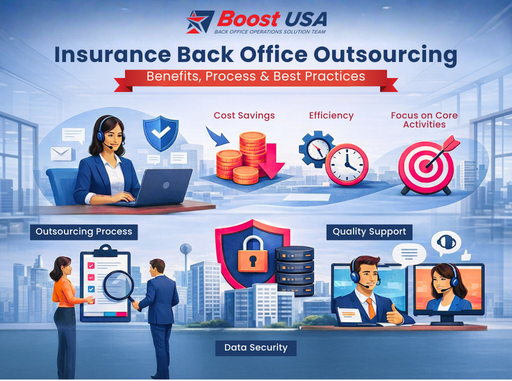
Insurance never sleeps. Claims keep coming, data keep piling up, and policies keep changing. But when the in-house team is stuck in paperwork instead of focusing on what truly matters, growth suffers. What if your back-office operations stop being a bottleneck and become a competitive edge? With back office outsourcing, it is possible.
Back office outsourcing transforms administrative burdens into an operational advantage. It removes administrative burden and gives insurance carriers an operational advantage, so they can do what they do best while experts handle the rest.
What is Insurance Back Office Outsourcing?
Back office outsourcing involves partnering with an expert team to manage administrative operations. For insurance companies, this includes data entry, document management, policy administration, claims processing support, billing operations, and compliance reporting.
Back office outsourcing companies provide trained professionals who understand the workflows. These professionals work around the clock, follow strict compliance standards, and scale to meet current needs. The goal of these services is not solely to reduce costs. It builds a strong foundation that supports accuracy, speed, and overall growth across insurance operations.
Why Do Insurance Companies Choose Back Office Outsourcing?
Modern-day insurance carriers face mounting pressure. Tightening regulations, rising customer expectations, and increased competition can hamper their growth.
Back-office outsourcing services address these challenges head-on and deliver improvements across many key areas.
Key drivers for outsourcing include:
Cost efficiency: It reduces overhead costs by up to 40% compared to maintaining a full in-house team.
Scalability: Handling the seasonal peaks without any hiring delays or additional seasonal costs.
Accuracy: Minimize the errors in policy data, claims processing, and billing operations
Speed: Reduce the turnaround times on the administrative tasks to a great extent (from days to hours).
Focus: Free up the core teams to concentrate on underwriting, sales, and customer relationships.
When insurance outsources back-office functions, they gain efficiency and growth.
Core Insurance Back Office Services Worth Outsourcing
All the tasks need outsourcing. However, certain functions deliver the best results when handled by a team of experts. These back-office tasks should be outsourced by the insurers.
Data Entry & Management | Policy data input, Claims data processing, Customer record updates | Eliminates backlogs, Improves data accuracy |
Document Processing | Scanning and indexing, Digital file management, Archive organization | Speeds retrieval, Ensures compliance |
Policy Administration | Renewal’s processing, Endorsement handling, Cancellation management | Reduces processing time, enhances customer experience |
Claims Support | Initial claims intake, Documentation verification, Status tracking | Accelerates claims cycle, Improves accuracy |
Billing Operations | Premium processing, Payment reconciliation, Invoice generation | Ensures timely payments, reduces disputes |
Compliance Reporting | Regulatory documentation, Audit trail management, Report preparation | Maintains compliance, reduces risk |
Each of these services connects to the broader insurance operations; when one area improves, the entire system benefits.
The Back Office Outsourcing Process: How It Works
Successful outsourcing needs a strategically made, tailored approach. Back-office outsourcing companies that deliver the best possible results focus on integration, not just on completing tasks. Here’s how the process works:
Phase 1: Assessment & Planning
In the first phase, the outsourcing partner analyzes the current workflows, identifies bottlenecks, and assesses the existing processes. Clear goals mean reduced cycle time and increased accuracy.
Phase 2: Integration & Setup
Technology connects your systems with the outsourced team, and the training ensures that the external team understands your specific insurance products, compliance requirements, and quality standards.
Phase 3: Execution & Monitoring
Operations begin with clear metrics tracking performance. Regular metrics reports show progress on accuracy, volume, and speed. Communication channels stay open for quick adjustments.
Phase 4: Optimization & Scaling
Workflow automation is introduced when processes stabilize, so teams can scale up during busy periods and adjust during slower times. This helps in continual improvement.
Best Practices for Insurance Back Office Outsourcing
Getting outsourcing right requires clear standards and smart planning. Companies that succeed follow these tested practices:
- Choosing the certified partners: Selecting ISO 27001 and SOC 2 compliance partners ensures data security.
- Starting with the pilot projects: Testing processes on smaller volumes before deploying them on a full scale.
- Maintaining clear communication: Regular check-ins and reporting keep the operations well-aligned.
- Setting measurable goals: Tracking specific KPIs like accuracy rates, processing times, and cost per transaction helps set measurable goals.
- Investing in integration: Investing in integration, like connecting systems properly to avoid.
- Planning for scale: Build flexibility into contracts to handle growth or market changes.
- Prioritizing data security: Ensure encryption, access controls, and audit trails for meeting the latest industry challenges.
These practices turn outsourcing from a costly endeavor to a competitive advantage.
Measuring Success: Key Performance Indicators
Do you know how to track back-office outsourcing? Track these metrics:
- Processing accuracy: Target 99.5% or higher
- Turnaround time: Measure daily, weekly, and monthly cycle times
- Cost per transaction: Compare before and after outsourcing
- Backlog reduction: Track pending items monthly
- Customer satisfaction: Monitor complaints related to administrative errors
- Compliance adherence: Zero tolerance for regulatory violations
Regular reviews of these indicators help you keep aligned with your outsourced partner.
Boost USA: Your Partner in Insurance Back Office Excellence
Boost USA has complete expertise and can transform insurance operations through certified back-office outsourcing. We are SOC2 compliant and ISO 27001 certified, and we are known for delivering secure, accurate, and scalable support that insurers can rely on.
What sets us apart:
- 24/7 operations ensuring continuous coverage across all time zones
- Insurance-specific expertise spanning policy administration, claims support, and billing operations
- Advanced workflow automation that integrates seamlessly with existing systems
- Proven track record of reducing backlogs by 70% and cutting processing times in half
- Certified security standards protecting sensitive insurance data
From data entry to document management, from billing to compliance reporting, we handle the administrative details so that your team can focus on growth, innovation, and customer service.
Final Thoughts:
Insurance leaders do not win by working harder. They win by building smarter and faster operations. Back-office outsourcing is no longer a cost-saving tactic. It is a growth strategy that can turn complexity into complete control, speed into advantage, and administration into momentum. Hence, the question is not whether you should outsource. The question is whether you can afford not to outsource.
FAQs
What functions are typically included in insurance back office outsourcing?
Insurance back-office outsourcing typically covers policy administration, data entry, underwriting support, claims processing, billing, and customer record management. It may also include compliance reporting, document management, and analytics support. These functions are routine, process-driven, and non-customer-facing.
How does back office outsourcing improve efficiency for insurance companies?
Outsourcing improves efficiency by reducing operational costs and speeding up turnaround times through specialized teams and automation. It allows insurers to scale operations quickly without hiring or training in-house staff. This frees internal teams to focus on core activities like product innovation and customer engagement.
What is the process for transitioning to an outsourced back office model?
The transition typically starts with identifying suitable processes and selecting a qualified outsourcing partner. This is followed by process documentation, knowledge transfer, system integration, and pilot testing. Once stabilized, operations are gradually scaled with ongoing performance monitoring.
What best practices ensure successful insurance back office outsourcing?
Successful outsourcing depends on clear SLAs, strong data security measures, and regular communication with the vendor. Choosing a partner with insurance domain expertise is critical. Continuous monitoring, process optimization, and governance help maintain quality and compliance.
Ready to Turn Your Back Office Into a Growth Engine?
Stop letting delays, backlogs, and administrative pressure hamper your growth. Every day that you wait is another day that your competitors move faster than you. Visit Boost USA and take the first decisive step toward faster claims, cleaner data, happier customers, and unstoppable growth. Act now and don’t let your operations suffer another slow day.