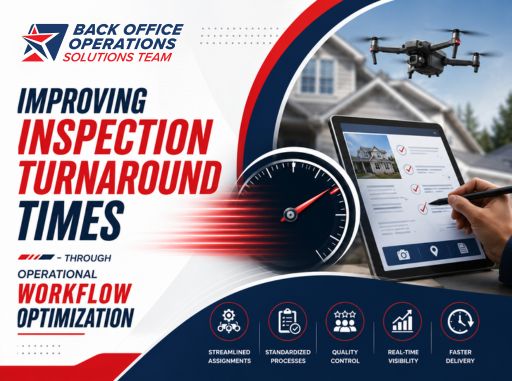
Inspections that are reviewed for long periods slow underwriting decisions, delay policy issuance, and cause customers to have a bad experience. Most organizations assume the problem lies with inspectors in the field. In reality, the biggest problem is often an inefficient Operational Workflow that creates delays long after the inspection is complete.
A well designed Operational Workflow keeps inspections moving without flaws, from scheduling and field completion through quality review, reporting, and underwriting, without unnecessary handoffs or administrative bottlenecks.
Organizations that optimize these internal processes consistently reduce inspection turnaround times, improve operational efficiency, and make faster, more confident underwriting decisions.
Why Inspection Turnaround Problems Are Rarely About the Inspector
When carriers and MGAs investigate slow turnaround, the instinct is to look at inspector capacity. Hire more field consultants, the thinking goes, and the backlog clears.
In practice, the bottleneck usually sits in the operational workflows, the sequence of scheduling, dispatch, data capture, review, and system entry that surrounds every inspection. A consultant can complete a site visit in an hour and still leave the report sitting in an inbox for a week because no one owns the handoff between “inspection done” and “report processed.”
Industry data backs this up. One mid market carrier that automated submission and intake work before touching any underwriting decision logic cut quote turnaround from three to five business days to under four hours, according to a 2026 P&C automation analysis.
Where Inspection Scheduling Efficiency Breaks Down
Inspection scheduling efficiency depends on more than a calendar. It depends on territory assignment logic, inspector availability tracking, and a system that routes the right job to the right consultant without manual back and forth.
Most in-house teams manage this through some combination of spreadsheets, email chains, and whichever platform happens to be open that day. Every manual handoff is a place where a file lies untouched for extended periods.
The programs that scale without falling behind treat scheduling as its own workflow, not an afterthought bolted onto the inspection process.
A Look at Where Inspection Workflow Time Actually Goes
Workflow Stage | Common Manual Process | Optimized Process |
Scheduling & dispatch | Email/phone coordination, 2 to 4 day lag | Centralized queue, same day assignment |
Data capture | Paper forms, manual reentry | Digital forms, direct system sync |
QA review | Ad hoc, inconsistent standards | Structured review checklist, consistent SLA |
Recommendation routing | Manual follow up, easily missed | Tracked workflow with automated reminders |
Underwriting handoff | Batch delivery, delayed visibility | Real time or near real time delivery |
The pattern across every row is the same. Manual handoffs create lag. Structured workflow removes it.
How Insurance Process Automation Improves Inspection Workflows
A common misconception is that insurance process automation means removing people from the loss control process. It doesn’t. The judgment calls, hazard assessment, risk classification, and recommendation language still belong to trained consultants. What automation and structured workflow remove is the busywork around that judgment: rekeying data, chasing status updates, and manually routing files between systems.
When that layer is cleaned up, the same team improves underwriting turnaround without adding headcount or cutting corners on report quality.
What an Optimized Inspection Workflow Looks Like in Practice
Carriers that have restructured their inspection workflow typically start with an audit: Where does a file sit the longest, and why? In most cases, the answer is not the inspection itself. It is the three or four handoffs surrounding it. Fixing scheduling logic, standardizing data capture, and building a consistent QA step before ever touching headcount is usually where the fastest wins appear.
Final Thoughts
Inspection turnaround times are not simply a measure of operational efficiency. They are a direct reflection of how effectively an insurance organization can assess risk, serve customers, and remain competitive. While adding more field inspectors may seem like the obvious solution, the greatest improvements often come from optimizing the Operational Workflow that supports every inspection.
By eliminating manual bottlenecks, standardizing processes, and creating seamless handoffs from scheduling through underwriting, insurers can accelerate decision making, improve report quality, reduce operating costs, and deliver a faster, more reliable customer experience. In an industry where speed and accuracy increasingly define success, investing in a smarter Operational Workflow is an investment in long term growth, scalability, and operational excellence.
FAQs:
How can workflow optimization improve inspection turnaround times?
Workflow optimization reduces delays by streamlining scheduling, data capture, quality reviews, and report routing. This helps inspection reports reach underwriters faster, improving turnaround times and operational efficiency.
What operational challenges slow down insurance inspection turnaround times?
Common challenges include manual scheduling, inefficient data entry, inconsistent quality reviews, poor communication between teams, and delays in routing reports to underwriters. These bottlenecks slow the entire inspection process.
Eliminate Inspection Delays with a Smarter Operational Workflow Today!
Turnaround time is a workflow metric, not a staffing metric. Programs that treat it that way see faster underwriting decisions, fewer bottlenecks, and inspection teams that scale without breaking. The fix rarely requires more people. It requires a workflow built to move files rather than hold onto them.
If your inspection reports are getting done but not getting through, the problem is almost always upstream of the field. Boost USA’s Operational Administration & Workflow Management services are built to identify exactly where your inspection workflow is losing time and rebuild it so that reports move from the field to the underwriting desk without delays.
Schedule a free workflow assessment to see where your program is losing days it does not need to.