
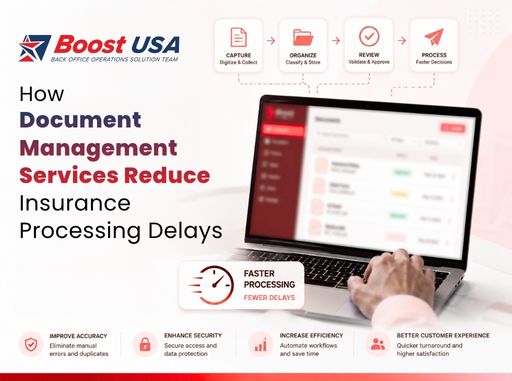
The policy was submitted on Tuesday. By Friday, the inspection report was still missing. It had been filed under the wrong account, buried under outdated naming conventions, and disconnected from the workflow that needed it most. The delay was not caused by volume or lack of effort. It was caused by the absence of structured document management services designed to keep insurance operations moving accurately and on time.
This situation is far more common in insurance operations than most organizations admit. For carriers, MGAs, and risk management firms handling large volumes of delays and documents, this situation is caused by unstructured document workflows.
Effective document management services solve this problem by creating systems that organize, track, validate, and route documents consistently from the moment they enter the operation.
Where Insurance Processing Delays Actually Begin
Most insurance organizations blame delays on workload volume. In reality, the bigger issue is usually the absence of structure. When document handling depends on personal habits, shared inboxes, manual naming conventions, and disconnected systems, inconsistency becomes unavoidable.
One employee may save files one way while another handles them differently using a separate process. New hires bring variations, and over time those differences create operational bottlenecks. The result is a workflow where documents are misplaced, duplicated, outdated, or never routed to the correct department.
This breakdown can happen at any stage:
- An inspection report is uploaded but never linked to the underwriting file.
- A policy endorsement is processed, but the updated version never reaches the claims team.
- A compliance document sits unread because no one owns the inbox it was sent to.
These problems do not require negligence to occur. They happen naturally when no structured workflow exists to guide the movement of documents across teams.
The most damaging issues are often not obvious. A file may appear complete while still containing outdated data, missing context, or incorrect versions. Those errors then carry forward into underwriting decisions, claims handling, billing, and compliance reviews.
Workflow and document standardization are one of the most valuable operational improvements available to insurance organizations because structured inputs lead to faster and more accurate outcomes across the business.
How Structured Document Management Services Improve Insurance Operations
Effective insurance records management is much more than just digital storage. It is a disciplined operational process applied consistently across every document type, including inspection reports, claims files, policy endorsements, billing records, compliance submissions, and customer correspondence.
When structure is introduced at the point of document intake, several improvements can happen immediately.
Faster Document Retrieval
Documents are named, categorized, indexed, and linked to the correct account as soon as they arrive. Instead of employees searching across emails, folders, or disconnected systems, information becomes accessible within seconds. For underwriters and claims teams working against tight timelines, this dramatically reduces delays.
Reduced Processing Errors
Policy documentation automation removes many of the manual judgment calls that create inconsistency. The system validates whether a document is complete, properly categorized, and routed to the correct workflow before it can move forward.
This prevents errors caused by rushed manual handling or competing priorities.
Continuous Audit Readiness
Insurance organizations face strict documentation and compliance requirements. Structured workflows ensure that records are traceable, timestamped, version controlled, and stored in the correct format at all times.
Instead of preparing for audits reactively, organizations remain audit ready continuously.
Structured vs Managed Insurance Document Workflows
Document Function | Unstructured Workflow | Managed Workflow | Operational Result |
Inspection Reports | Files saved inconsistently | Standardized intake and account linking | Faster retrieval |
Policy Endorsements | Version confusion | Version controlled records | Accurate underwriting decisions |
Compliance Submissions | Inbox based tracking | Logged and routed automatically | Improved audit readiness |
Claims Documentation | Siloed by adjuster | Centralized access controls | Faster claims handling |
Billing Records | Manual reconciliation | System linked validation | Fewer billing errors |
Backlog Processing | Existing staff overloaded | Dedicated processing support | Faster backlog clearance |
How Insurance Workflow Management Supports Scalability
Most document delays are not information problems. They are workflow problems. Documents do not simply “get lost.” Workflows fail to define where documents should go, who owns them, and what validation steps should happen before the next stage begins.
Insurance workflow management solves this by creating:
- Defined routing rules
- Validation checkpoints
- Ownership responsibilities
- Automated notifications
- Consistent archival processes
Once these rules are standardized, operations become predictable. Turnaround times become measurable, and exceptions can be identified before they grow into major delays.
This structure also supports scalability. Teams relying on institutional memory and manual habits struggle when document volume increases significantly. Every increase in workload creates additional strain.
Structured document management services allow organizations to absorb growth more efficiently because the workflow itself carries much of the operational burden rather than individual employees managing everything manually.
For insurance carriers expanding their policy volume or claims operations, this creates a major operational advantage.
Final Thoughts on Insurance Document Processing Delays
Insurance processing delays are rarely caused by employees alone. More often, they result from inconsistent systems and undefined workflows. When insurance document processing lacks structure, every employee handles files slightly differently. Over time, those small inconsistencies lead to longer cycle times, missing records, compliance risks, and frustrated teams spending hours locating documents that should take seconds to access.
Frequently Asked Questions About Document Management Services
How do document management services improve insurance processing efficiency?
Document management services improve insurance processing efficiency by organizing, storing, tracking, and retrieving files through standardized workflows and centralized systems. This reduces manual errors, speeds up document access, improves compliance, prevents version confusion, and allows underwriting, claims, and administrative teams to process work faster and more accurately.
What causes insurance processing delays without structured document management services?
Without structured document management services, insurance processing delays are often caused by misplaced files, inconsistent naming conventions, manual data entry, duplicate records, outdated document versions, and slow retrieval processes. These inefficiencies create workflow bottlenecks, increase administrative burden, and slow decision making across claims, underwriting, and compliance operations.
Stop Losing Time to Disorganize Insurance Document Workflows! Act Today
Boost USA’s Operational Administration Workflows service gives insurance carriers, MGAs, and risk management firms the structured document and records management, data validation, workflow coordination, and demand spike support they need to operate accurately at scale without building the infrastructure internally. Get in touch with us today!