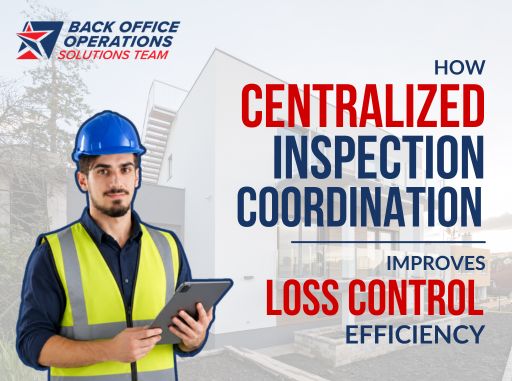
Your inspection program may be generating reports, but is it actually improving loss control efficiency? For many MGAs, insurance carriers, and claims administrators, the biggest challenge is not completing inspections. It is managing everything that happens before and after them.
Scheduling delays, scattered communication, inconsistent quality checks, manual data entry, and poor follow-up on recommendations can slow operations and increase risk. Centralized inspection coordination solves these problems by bringing the entire inspection lifecycle under one dedicated team and streamlined process. The result is faster turnaround times, greater visibility, consistent execution, and far better loss control efficiency across every inspection.
What Is Centralized Inspection Coordination for Better Loss Control Efficiency
Centralized inspection coordination means one team owns scheduling, dispatch, territory assignment, desk review, and recommendation follow-up for every insurance inspection instead of those steps being handled by whichever department happens to touch them.
In a decentralized setup, an underwriter requests an inspection, a regional office schedules it, an inspector files a report into one platform, and an administrative staff member manually reenters the findings into another. Every handoff creates an opportunity for something to slip through the cracks. A centralized model eliminates these issues and creates a single coordinated workflow in which one team is accountable for the inspector’s calendar, the report’s quality, and the recommendation’s deadline. Nothing moves to the next stage until that team signs off on it.
How Workflow Gaps Reduce Loss Control Efficiency
Most loss control programs do not lose efficiency in the field. They lose it in the gaps between the field and the office. Inspector territories are assigned reactively instead of being planned around geography and workload, so one inspector drives across three counties while another sits idle.
Reports land in a queue with no standard review process, so errors surface only after an underwriter has already acted on incomplete data. Recommendation letters go out, but no one tracks whether the insured actually completed the work, leaving carriers exposed to the very hazards the inspection was meant to identify.
Each of these gaps seems small on its own. Stacked together across hundreds of inspections each month, they become the difference between a loss control program that supports underwriting and one that quietly works against it.
Inspection Scheduling: Decentralized vs. Centralized
KPI | Decentralized Coordination | Centralized Inspection Coordination |
Inspection turnaround time | 10 to 14 days, varies by region | 40% to 50% faster, consistent nationwide |
Report defect/rework rate | High. Errors caught after submission | 60% to 70% lower. QA built into the workflow |
Recommendation follow-up | Tracked manually and inconsistently | Automated 30 and 45 day reminder cadence |
Inspector utilization | Uneven. Some overbooked, some idle | Balanced through territory based routing |
System data entry | Rekeyed across platforms and error prone | Single pass into LC360 and carrier systems |
How Centralized Inspection Scheduling Improves Workflow Optimization
Centralizing inspection coordination does not simply move the same tasks under one roof. It changes how they are completed. Territory based routing assigns inspectors according to location and workload rather than whoever is available, reducing drive time and balancing caseloads. Desk review takes place before a report reaches underwriting instead of afterward. This catches missing photos and incomplete sections while the inspector can still address them quickly.
Recommendation tracking runs on a fixed cadence, typically with 30 and 45 day reminders. As a result, follow-ups happen automatically instead of relying on someone to remember. Industry analysis of inspection scheduling automation points to the same conclusion: matching inspector routing to account location and certification requirements is what actually drives efficiency gains, not simply digitizing paperwork. According to FirmAdapt’s guide to insurance inspection scheduling automation, optimizing the workflow itself delivers greater operational improvements than simply automating individual tasks. That is workflow optimization in practice: redesigning the sequence of work rather than merely speeding up each individual step.
The Business Impact of Better Loss Control Efficiency
The numbers back this up. Insurance carriers that centralize their inspection coordination typically see turnaround times drop by 40% to 50%, with most reports completed within days rather than weeks after the field visit.
Report defect rates, meaning the errors and omissions that require reports to be sent back for rework, fall by 60% to 70% compared with programs that do not use standardized desk review. Underwriters receive cleaner data faster, allowing policies to be priced based on current risk rather than stale or incomplete information. Compliance documentation also remains centralized instead of being scattered across multiple departments.
That is the real payoff of centralized inspection coordination: not just fewer operational headaches, but a measurable improvement in the quality of data that underwriting decisions rely on.
Final Thoughts
Improving loss control efficiency is not about asking inspectors to work harder. It is about creating a smarter, more accountable process that eliminates delays, reduces manual effort, and ensures every inspection delivers actionable value.
As inspection volumes grow and underwriting decisions become increasingly data driven, carriers that invest in centralized coordination gain a clear operational advantage. With the right workflows, technology, and dedicated support team in place, every inspection becomes more than a compliance task. It becomes a strategic asset that helps reduce risk, improve underwriting confidence, and strengthen long term business performance.
FAQs
How does centralized inspection coordination improve loss control efficiency?
Centralized inspection coordination streamlines scheduling, communication, quality assurance, and follow-up through a single process. This reduces delays, minimizes errors, and helps loss control services operate more efficiently.
What are the benefits of centralized inspection coordination for insurance carriers and MGAs?
Centralized inspection coordination improves operational efficiency, speeds up inspection turnaround times, enhances compliance, and provides better visibility into every inspection. It also helps insurance carriers and MGAs reduce administrative workloads while delivering a more consistent client experience.
Build Centralized Inspection Coordination Into Your Loss Control Program With Boost USA
Boost USA’s Territory Manager Support gives insurance carriers, MGAs, and claims administrators a single centralized team that handles inspection scheduling, territory assignment, desk level QA, and recommendation follow-up while integrating directly with LC360 and your existing systems.
Instead of inspection coordination being spread across three departments and countless spreadsheets, you get one accountable team responsible for every stage of the workflow, with the flexibility to scale up during renewal surges and scale back once volume settles.
Talk to Boost USA about centralizing your inspection coordination to see what it would take to bring your loss control program under one roof.