A policyholder calls about a renewal question. The call sits in the queue behind eleven others. By the time someone picks up, the caller has already opened a competitor’s website in a second tab. This is not a staffing problem in the way most carriers describe it. It is a capacity problem, and Business Process Outsourcing is how forward-thinking insurers are solving it. They do not add headcount. They rebuild how the work gets done.
Key Takeaways
- Business Process Outsourcing helps insurers improve service levels by increasing operational capacity, not just reducing costs.
- Outsourcing routine, high-volume tasks enables internal teams to focus on underwriting, claims decisions, and customer relationships.
- A well-managed BPO strategy strengthens insurance workflow management, shortens turnaround times, and improves policyholder satisfaction.
- Insurance-specific outsourcing partners deliver measurable gains in efficiency, scalability, and compliance without adding permanent headcount.
How Business Process Outsourcing Reduces Insurance Operating Costs
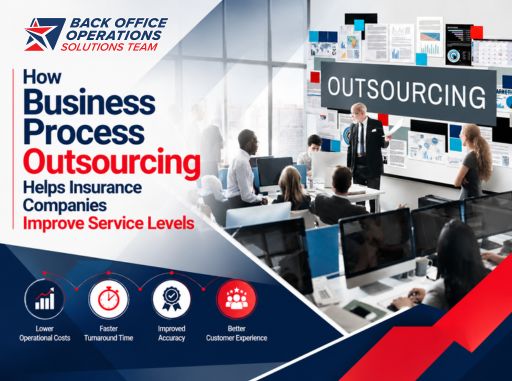
Business Process Outsourcing lets insurers hand off high-volume, repetitive work, policy administration, data entry, billing, and customer service to a specialized partner so internal teams can focus on underwriting and growth. When done right, it improves response times, strengthens insurance workflow management, and cuts operating costs by 40 to 60% without sacrificing accuracy.
What Business Process Outsourcing Means for Insurance Companies
Insurance business process outsourcing is the practice of contracting a specialized partner to handle administrative, operational, and support functions that do not need to happen in-house. Common outsourced functions include policy administration, claims support, data entry, document processing, billing, customer service, and reporting. It is not a replacement for internal expertise. It is a way of separating repetitive execution from the strategic decisions only an insurer’s own team can make.
Why Process Outsourcing Matters for Insurance Operations Today
Policyholder expectations have compressed faster than most carriers’ internal capacity has scaled. Recent research on insurance response benchmarks found that 90% of customers now expect an immediate reply to a service inquiry, and 60% define “immediate” as under 10 minutes.
Most internal teams, buried in policy updates, endorsements, and compliance documentation, simply cannot hit that bar consistently. That gap is where Business Process Outsourcing earns its place, not as a cost play but as the mechanism that keeps service levels aligned with what the market now demands.
As insurers adapt to changing customer expectations, improving operational efficiency and maintaining strong consumer service standards have become critical priorities. The National Association of Insurance Commissioners (NAIC) provides industry resources and guidance on insurance regulation, consumer expectations, and market practices that influence how carriers operate and serve policyholders.
Business Process Outsourcing Impact by the Numbers
Function | In-House Challenge | Outsourced Outcome |
Policy administration | Manual processing backlogs | Faster turnaround, fewer errors |
Customer service support | Long queue times, inconsistent responses | 24/7 coverage, standardized response quality |
Billing and document processing | Staff pulled from core work | Dedicated teams, consistent accuracy |
Compliance reporting | Reactive, audit scrambles | Documented, audit-ready workflows |
Operating cost | Fixed overhead regardless of volume | 40 to 60% reduction on outsourced functions |
Industry Insight on Insurance Business Process Outsourcing
Backlogs are rarely a single bottleneck. They are usually the accumulated effect of several under-resourced functions, billing, data entry, and customer follow-up, running at capacity simultaneously. Carriers that outsource in isolated pockets often see partial relief. Carriers that treat BPO as a connected operating model see the full effect because each improved function reduces pressure on the next one downstream.
Case Study: Reducing Insurance Backlogs Without Adding Headcount
A mid-sized carrier managing policy administration, billing, and customer inquiries entirely in-house was seeing processing backlogs stretch into weeks during renewal season, with service calls routinely going unanswered for hours. After shifting document processing, billing operations, and Tier 1 customer service support to a dedicated outsourced team operating around the clock, the carrier cut its backlog significantly and brought processing times down by roughly half, without hiring a single additional in-house employee.
Best Practices for Insurance Workflow Management
- Start with a clear inventory of which tasks are repetitive, time-intensive, and non-strategic.
- Choose a partner with insurance-specific expertise, not a generalist BPO vendor.
- Require integration with your existing systems rather than forcing a workaround.
- Set measurable service level targets, including response time, accuracy rate, and turnaround, before go-live.
Common Business Process Outsourcing Mistakes Insurance Companies Should Avoid
- Outsourcing without defining success metrics upfront.
- Choosing cost savings over insurance-specific expertise.
- Treating BPO as “set and forget” instead of an ongoing operational partnership.
- Failing to secure certifications such as SOC 2 and ISO 27001 before handing off sensitive data.
Practical Checklist for Selecting an Insurance BPO Partner
- Have you identified which functions are dragging down service levels?
- Does your partner have documented insurance industry experience?
- Are security certifications verified, not assumed?
- Is there a clear onboarding timeline with defined milestones?
Final Thoughts:
Insurance carriers are no longer competing only on products and pricing. They are competing on speed, responsiveness, and the quality of every policyholder interaction. Business Process Outsourcing gives insurers the operational capacity to close service gaps, reduce backlogs, and create more efficient workflows without adding unnecessary internal complexity.
By moving repetitive, time-intensive processes to specialized insurance experts, carriers can empower their teams to focus on higher-value decisions while delivering faster, more consistent service. In a market where every customer interaction can influence retention, BPO is not just a cost-saving strategy. It is a strategic advantage for building a more agile, scalable, and future-ready insurance operation.
FAQs
How does Business Process Outsourcing improve insurance customer service support?
It gives carriers dedicated, around-the-clock capacity for routine inquiries, freeing internal staff to handle complex cases while outsourced teams manage volume, response time, and consistency.
What insurance functions benefit most from business process outsourcing support?
Insurance functions that benefit most from Business Process Outsourcing support include policy administration, claims support, customer service, billing, data entry, document processing, compliance reporting, and reporting operations. These high-volume tasks can be streamlined through BPO, allowing internal teams to focus on underwriting, risk assessment, and customer relationships.
Ready to Improve Your Insurance Operations? Get in Touch With Us Today!
Close service gaps, reduce backlogs, and improve efficiency with Boost USA’s insurance-focused Business Process Outsourcing solutions. From policy administration to customer support, our experts help carriers streamline workflows, scale operations, and deliver better policyholder experiences.
Get your free outsourcing assessment today and discover how BPO can help your team work smarter, faster, and more efficiently.