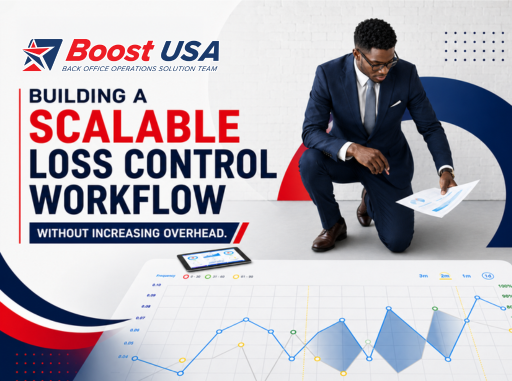
Most loss control programs do not break under pressure. They simply stop scaling. This distinction matters. Many organizations assume their loss control workflow is effective because it functions well today. But a workflow that works at 500 inspections often struggles at 5,000.
When inspection volume is manageable, informal systems hold. Territory managers know their inspectors personally. Reports get reviewed by whoever has a few minutes. Recommendations are tracked in spreadsheets that someone updates when they remember to. The program works because the team makes it work, not because the loss control workflow is designed to carry the weight.
Then the volume increases. A new book of business comes on, or a carrier partner expands its geographic appetite. The MGA adds three new lines, and suddenly, the loss control workflow management system that never really existed becomes painfully and expensively obvious.
Here is an honest observation: most of the overhead problem in loss control is not headcount. It is friction, which means unnecessary touches, manual handoffs, redundant reviews, and administrative tasks that qualified consultants should never be doing in the first place.
What Creates Overheads in the Insurance Inspection Process
The assumption is that scaling requires hiring. In practice, overhead grows not from volume alone, but from volume meeting a workflow that was never engineered for it.
Consider what a typical insurance inspection process looks like inside a mid-sized carrier or MGA: an inspector submits a report; it routes to a territory manager for review; that manager flags missing data or a nonstandard recommendation; the inspector revises and resubmits; and the revised report eventually reaches underwriting, sometimes days later. These are the issues that lead to delays and confusion. When that sequence runs through email threads and shared drives, the time cost multiplies with every inspection.
In most cases, the loss control operations efficiency problem is not that teams are slow. It is the process itself that generates unnecessary work.
Four Ways to Create Scalable Insurance Workflows
There are four places where the right intervention creates scalable insurance workflows without adding proportional headcount.
Pre-Submission Quality Gates
The single highest-leverage change most loss control programs can make is to move error detection earlier. When QA happens after a report reaches the desk, the cost of correction is high: inspector time, reviewer time, and underwriting delays.
When automated flags catch missing photographs, incomplete occupancy data, or mismatched fields before submission, the defect rate drops, and so does rework. In our experience working with carriers, pre-submission QA reduces downstream correction volume by 60 per cent or more.
Guided Self-Inspections for Lower-Complexity Risks
Not every property in a book warrants a full field inspection. For lower-hazard commercial risks, guided self-inspections, in which the insured or a designated contact completes a structured photo-and-questionnaire workflow, can replace traditional inspections at a fraction of the cost.
The keyword is guided. Unstructured self-reporting produces unreliable data. A well-designed guided process with purpose-built forms and clear validation criteria produces data that underwrites comparably to a field visit for the appropriate risk tier.
Centralized Recommendation Tracking
This is the area where overhead accumulates most invisibly. Open recommendations that are never formally tracked, followed up on, or closed create compliance exposure.
They create work. Someone is always chasing the status of something. An automated system that sends structured follow-ups at 30 and 45 days, logs responses, and produces exception reports eliminates that chase almost entirely.
Separating High Judgment Work from High Volume Work
Loss control consultants and territory managers are expensive, experienced professionals. When they spend a meaningful portion of their day scheduling, formatting reports, data entry, or managing email threads, that is a structural problem, not a staffing one.
Offloading administrative workflow to a dedicated back-office operation that operates within your systems and on your timelines frees consultants for field and analytical work that actually requires their expertise.
Loss Control Workflow Management Data and Performance Insights
The industry’s own numbers make a clear case for structural change over headcount expansion.
Workflow Approach | Average Cost vs. Field Inspection | Average Turnaround Time | Defect Rate Impact |
Traditional field inspection (unstructured QA) | Baseline | 5 to 10 business days | High variability |
Field inspection plus embedded pre-submission QA | 5 to 8 per cent upfront | 3 to 5 business days | 60 to 70 per cent defect reduction |
Guided self-inspection (structured) | 50 per cent or more savings | 1 to 3 business days | Comparable when the form is designed |
Video-guided remote inspection | 25 per cent or more savings | 2 to 4 business days | Strong with the QA layer |
Outsourced back office plus QA support | 40 to 60 per cent savings on administrative functions | Next day processing | 99 per cent or more QA accuracy is achievable |
The pattern here is worth noting: the biggest efficiency gains come not from doing inspections differently, but from what happens around inspections, including intake, review, tracking, and administrative handling.
How to Measure Loss Control Operations Efficiency
Here is a diagnostic worth running internally. Take ten randomly selected inspection reports from the last quarter. For each one, map every person who touched it from submission to underwriting delivery, including every email, revision request, or status follow-up. Count the total touches. Compare that to the minimum number of touches required if the process had worked the first time perfectly.
The gap between those two numbers is your overhead. It is not inevitable. It is the cost of a workflow that was designed for a smaller, simpler operation and never updated.
Programs that have run this exercise typically find three to six unnecessary touches per report. At scale, that is the equivalent of one or two full-time positions consumed by friction rather than value.
Scaling a Loss Control Workflow Without Increasing Headcount
The goal of a scalable loss control workflow is not to eliminate human judgment. It is to reserve human judgment for decisions that actually require it. Pre-submission automation handles the predictable. Guided self-inspections handle the appropriate. Centralized recommendation systems handle the administrative follow-up. This leaves consultants, reviewers, and territory managers working on assessments, edge cases, and underwriting conversations that move the needle.
That is where expertise belongs. And that is exactly the kind of program that scales.
Final Thoughts:
The organizations that scale loss control successfully are not necessarily the ones with the largest teams or the biggest budgets. They are the ones who design their workflows intentionally. Every unnecessary review, manual handoff, and administrative task compounds as inspection volume grows, creating costs that eventually limit growth.
The most effective loss control programs remove friction before it becomes overhead, allowing consultants and underwriters to focus on decisions that require expertise rather than process management. In a market where speed, consistency, and operational efficiency directly impact profitability, building a scalable loss-control workflow is no longer merely an operational improvement. It is a competitive advantage.
FAQs:
How can insurers build a scalable loss control workflow without significantly increasing operational costs?
By reducing manual steps, removing process friction, and using automation to handle repetitive tasks. Insurers should shift quality checks earlier in the workflow, standardize data collection, and use structured digital systems instead of email and spreadsheets. This allows them to handle higher inspection volumes without proportional increases in headcount or overhead.
What are the key components of an efficient and scalable loss control workflow?
- Pre-submission quality checks to reduce errors and rework
- Guided self-inspections for low complexity risks
- Centralized recommendation tracking for consistent follow-up and closure
- Automation or back office support for administrative tasks
- Clear separation of high judgment work from routine operational work
Ready to Build a Scalable Loss Control Workflow Without Increasing Overhead? Act Today!
Boost USA delivers end-to-end loss control workflow management for insurance carriers, MGAs, and risk management firms, including guided self-inspections, BoostRM™ recommendation management, pre-submission QA, and full back office support. Our SOC 2 Type 2 and ISO 27001-certified operations integrate directly with your existing systems, including LC360, and are live within 2 to 4 weeks of contract signing.
Most clients reduce operational costs by 50% or more without sacrificing turnaround speed or report quality. Schedule a free outsourcing assessment with Boost USA. One of our insurance operations experts will review your current workflow and show you exactly where the friction is and what it is costing you.