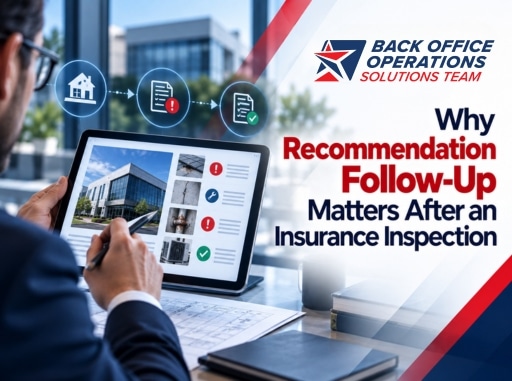
Finding a risk is not the same as fixing it. An inspector flags a damaged electrical panel at a warehouse. The inspector documents the recommendation and sends it out. But if no one follows up, the same panel can eventually cause a fire, a disruption, or a claim. That is where Recommendation Management matters. It turns inspection findings into tracked actions, verified fixes, and fewer preventable losses.
Key Takeaways
- An inspection finds hazards. Follow-up is what gets them fixed.
- Loss control recommendations only reduce risk when someone follows through.
- Recommendation tracking keeps issued items from going quietly stale.
- A clear risk mitigation workflow moves every item toward verified closure.
- Structured recommendation management gives underwriters confirmed conditions, not assumptions.
Why an Insurance Inspection Is Not the Finish Line
Loss control is a risk management technique built to lower both the chance and the severity of a loss, according to IRMI. Inspections are where that work starts. The recommendations they produce are where it pays off.
Loss control recommendations are the specific fixes an inspector asks for: repair this panel, guard that press, service that sprinkler. On paper, the job is done once the report lands. In reality, the hard part has not started.
Here is how the gap often plays out:
- Day 1: The report reaches the policyholder.
- Day 30: One reminder goes out.
- Day 60: No response. No one notices.
- Renewal: No one can say whether the hazard still exists.
Identifying a hazard does not remove it. Without recommendation follow-up, the inspection becomes a record of risk instead of a tool for reducing it.
The numbers point the same way. One industry guide, citing Zywave, puts average recommendation compliance near 41% and says automated recommendation tracking can lift it to 65 to 75%. The message is clear: open items rarely close on their own.
What Strong Recommendation Management Looks Like
Good recommendation follow-up is a process, not a favour to the insured. The best programs run a clear risk mitigation workflow with six stages:
- Centralized intake. Log every recommendation the moment the inspection ends, with an ID, hazard, required fix, and deadline.
- Risk-based priority. High-risk items run on a 30-day cycle, medium on 60, and low on 90.
- Automated reminders and escalation. Notices go out at set intervals, and silence triggers escalation.
- Threaded documentation. Photos, contractor invoices, and safety certificates attach to the item they resolve.
- Exception reporting. Open, overdue, and high-priority items surface before they escalate.
- Verified closure. Nothing is marked resolved until we review the evidence.
Each step is simple. Together, they make recommendation management a real underwriting support process instead of an inbox habit.
Why Recommendation Management Breaks Down
Most teams know they should follow up. Few can keep it going at scale. Here is why:
- Volume. A spreadsheet can stay honest at around 50 recommendations. A large portfolio carries thousands of tasks every quarter.
- Scattered records. Letters, replies, and photos live across inboxes and shared drives.
- Memory-based follow-up. Reminders depend on whoever remembers.
- No escalation. Silence from a policyholder rarely triggers action.
- Slow audits. Pulling the records for one account can take days.
None of these are people problems. They are system problems.
The Real Cost of Weak Recommendation Management
When follow-up slips, the damage rarely shows up as one line item. It builds slowly, and each piece is an underwriting consequence, not an admin inconvenience:
- Preventable claims. Known hazards turn into losses.
- Renewals on assumptions. Underwriters price without knowing whether the fix happened.
- Audit exposure. Auditors and reinsurers expect proof. The compliance tracking insurance teams can stand behind and need a dated trail for every item.
- Lost visibility. Managers cannot see what is open or overdue.
- Wasted inspection spend. You paid for findings that nobody acted on.
Benefits of Strong Recommendation Management
When follow-up runs well, the gains show up quickly. The payoff of disciplined recommendation management is practical:
- Fewer preventable claims. Known hazards get fixed before they cause damage.
- Sharper underwriting. Renewal decisions rest on documented, verified conditions.
- Audit-ready records. Retrieval takes minutes, not days.
- Lower operating cost. Less manual chasing and fewer lost items.
- Real visibility. Managers see open, overdue, and high-priority items at a glance.
- Better policyholder relationships. Insureds get clear guidance instead of a pile of unexplained deadlines.
Where is your loop open? Boost USA will map your current recommendation lifecycle in a focused 30-minute conversation.
Best Practices for Recommendation Management
You do not need a huge program to improve results. Start with these habits:
- Set deadlines by risk, not habit. Use 30 days for high-risk items, 60 for medium, and 90 for low.
- Require proof. Photos, invoices, and certificates beat “we fixed it.” Strong compliance tracking that insurance carriers rely on starts with logging every contact and critical date.
- Escalate automatically. Do not rely on someone remembering to chase.
- Look for patterns. Which accounts or industries keep ignoring loss control recommendations? Those are your next conversations.
- Keep admin away from underwriters. Let them focus on risk selection and pricing.
- Watch three numbers monthly. Track closure rate, overdue count, and time to close.
How Boost USA Helps With Recommendation Management
Boost USA tracks every inspection recommendation from issuance to documented, verified closure. Our recommendation management insurance services pair AI-assisted workflows with experienced insurance professionals, so your underwriters work from confirmed risk conditions, not assumptions.
BoostRM℠ manages the full lifecycle through six core capabilities:
- Customizable dashboard. One view of work orders and recommendation status, set up the way your team works.
- Comprehensive recommendation tracking. Log every client letter, sent or received. Critical dates are captured, and exception reporting is built in.
- Automated notifications and escalation. Reminders typically fire at 30 and 45 days, and overdue items escalate automatically.
- Threaded documentation. Evidence stays attached to the recommendation it resolves.
- Exception reporting. Open, overdue, and high-priority items surface before they escalate.
- Verified closure. An item closes only after the evidence is reviewed and the fix is confirmed.
Every inspection’s follow-up plan also includes an assigned Loss Control Professional. They answer questions and guide the policyholder toward compliance, so follow-up feels like help, not a string of reminders.
We work inside the systems you already use, with extensive LC360 experience, and operate under SOC 2 Type 2 and ISO 27001 certifications. A clean risk mitigation workflow plugs into your loss control, policy administration, and claims platforms. We also support ARCO, TMPAA, and NAMIC member organizations.
As part of our insurance BPO offering, outsourced recommendation management takes the administrative load off your underwriters. They keep the work only they can do.
Final Thoughts
An inspection is only the first half of risk control. The second half is making sure every recommendation is fixed, documented, and verified.
Teams that treat recommendation follow-up as an underwriting function, not a back-office chore, close the loop faster. Teams that give recommendation management the same care as the inspection itself protect their book and renew with confidence. Findings turn into action, and action turns into fewer claims.
FAQs
What is recommendation management in insurance?
It is the process of tracking, communicating, and following up on the safety and risk recommendations issued in loss control inspection reports. It runs from issuance to documented, verified closure.
Why does recommendation follow-up matter after an inspection?
Identifying a hazard does not fix it. Without follow-up, the hazard stays in place, and the inspection becomes a record of risk instead of a tool for reducing it.
What should a recommendation tracking system include?
At a minimum, it needs central intake, risk-level deadlines, automated reminders, escalation, evidence logging, exception reports, and verified closure.
Why outsource recommendation management instead of handling it in-house?
Manual tracking works at low volume but struggles past roughly 50 active items. Outsourcing separates that administrative load from underwriting, so high-risk items stop slipping through, and your team stays focused on risk selection.
What happens when a policyholder does not respond?
Automated reminders go out at set intervals. When deadlines pass without a reply, the item escalates and appears in exception reports, so managers can act before it becomes a claim.
Ready to Close the Loop on Every Inspection? Act Today!
Boost USA will map your current recommendation management process in a focused 30-minute portfolio review. We will show you where the loop is open and how BoostRM℠ closes it. One of our insurance operations experts will reach out within one business day. Schedule a Portfolio Review with Boost USA.