
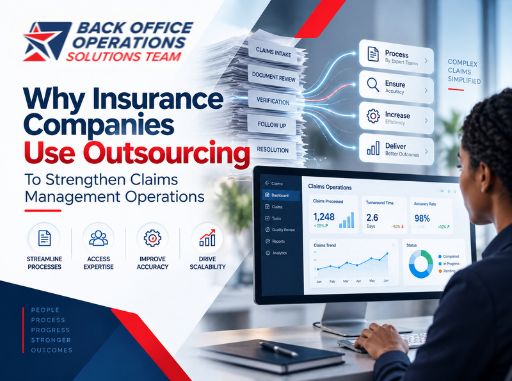
A claim can turn into a costly problem long before anyone notices it. Delays, missing data, and disconnected workflows can slow decisions and increase losses. Claims management brings the right data, people, and processes together to move claims forward faster, reduce errors, and keep costs under control.
Key Takeaways
- Claims management runs on speed, accuracy, and communication. Backlogs damage all three.
- Outsourcing absorbs routine work so adjusters can focus on judgment calls.
- Documented workflows improve consistency and audit readiness.
- The best partners combine AI, insurance expertise, and secure integration.
What Is Claims Management? A Quick Look
Claims management is the full journey of a claim, right from first notice of loss to final payment. It covers intake, document collection, coverage verification, investigation, settlement, and closure.
Much of this journey is administrative and repetitive. A single missing photo or unlogged call can stall an entire file. That is exactly the work specialist claims management services can absorb. The goal is not to replace your adjusters. It is to give them time back.
Claims Stage | Typical Bottleneck | What Outsourced Support Handles |
Intake | Data entry backlog, missing fields | Intake data entry, record checks |
Documents | Scattered emails, photos, forms | Indexing, filing, completeness checks |
Coordination | Follow ups fall through | Status updates, reminders, exception tracking |
Payments | Manual billing and reconciliation | Billing and financial admin support |
Reporting | Slow file retrieval | Standardized, traceable records |
Why Carriers Are Turning to Claims Management Outsourcing
Speed is now the benchmark. J.D. Power’s 2026 U.S. Property Claims Satisfaction Study found homeowners claims were fully resolved 3.4 days faster than last year, and overall satisfaction rose 20 points to 702.
Customers who are highly satisfied with the claims process are also the most likely to say they will renew.
Speed: Work moves overnight across time zones, so files are ready the next business day.
Savings: Most Boost USA clients save 40% to 60% on the functions they outsource.
Scale: Capacity rises and falls with claim volume, with no hiring cycle.
Accuracy: Trained teams follow documented SOPs, which cuts rework.
Focus. Adjusters spend their time on judgment, not data entry.
Factor | In House Only | With Outsourced Support |
Capacity | Fixed headcount | Scales with volume |
Ramp up | Months to recruit and train | Weeks to go live |
After hours coverage | Limited | Overnight processing |
Adjuster time | Split with admin work | Focused on decisions |
What to Outsource and What to Keep in Claims Management
Not every task belongs outside. Keep decisions that carry legal and relational weight: coverage determinations, settlement authority, negotiations, and fraud judgment.
Outsource the high volume work that slows those decisions down. That includes insurance claims processing tasks like data entry, document indexing, and file completeness checks. It also includes claims administration support such as status follow ups and record updates. Add billing and reporting, and you have a full claims operations support layer around your team.
How to Choose the Right Claims Management Outsourcing Partner
Ask five questions:
- Do they understand insurance, or only generic back office work?
- Are they SOC 2 Type 2 and ISO 27001 certified?
- Will they work inside your existing systems?
- Are SOPs documented and auditable?
- How do they handle exceptions?
Claims Management Metrics That Prove It Works
Outsourcing only earns its place if the numbers move. Baseline these before going live, then compare at 30, 60, and 90 days.
Metric | Why It Matters |
Cycle time (first notice to closure) | Shows overall speed |
First response time | Drives policyholder trust |
Rework rate | Reveals data accuracy |
Backlog age | Flags capacity gaps |
How Boost USA Helps With Claims Management
Boost USA is a full service insurance BPO partner built for insurers, MGAs, MGUs, and claims administrators. Our university educated, insurance native teams plug into your systems and handle the high volume work that slows claims management down:
- Insurance BPO for data entry, document processing, and policy administration support.
- Operational administration workflows that keep files moving and follow ups on schedule.
- Financial operations support for billing and reconciliation.
- AI assisted workflows, with human experts stepping in on every exception
Security is built in. Our operations are SOC 2 Type 2 and ISO 27001 certified, and client data stays inside your systems. Most engagements go live in 2 to 4 weeks, starting with a free outsourcing assessment to find your highest impact opportunities.
FAQs
How Does Data Quality Affect Insurance Analytics?
Data quality directly affects the accuracy of insurance analytics and the decisions based on it. Missing, inconsistent, or outdated information can produce misleading insights and increase underwriting risk. Validating data before analysis helps insurers work with more reliable information.
What Types of Data Are Used in Insurance Analytics?
Insurance analytics can use policy, claims, inspection, exposure, loss control, and customer data. Bringing these sources together can help insurers identify patterns that may not be visible when information remains separated. The value depends on how complete, accurate, and consistent the data is.
How Can Insurance Analytics Help Reduce Underwriting Risk?
Insurance analytics can help identify unusual patterns, missing information, and potential risk factors before a policy is bound. Predictive models can also highlight accounts that may require closer review. This gives underwriters additional information to support risk assessment and decision making.
How Can Insurers Improve Their Insurance Data Analytics?
Insurers can improve analytics by validating data at intake, standardizing data collection, connecting relevant systems, and tracking recommendations through completion. Regularly monitoring data quality and exception rates can also reveal recurring problems. Managed data operations can provide additional support without requiring insurers to build a larger internal team.
Final Thoughts
Policyholders forgive many things, but not silence during a loss. Carriers that fix the operational engine behind claims management protect retention, margins, and reputation together. Outsource the volume. Keep the judgment. Win the moment that matters and have an edge.
Ready to Strengthen Your Claims Management Operations? Act Today!
Book a free outsourcing assessment with Boost USA and identify where your team can reduce delays, improve efficiency, and move claims faster. Get a clear view of where expert support can simplify your workflow and strengthen your operations.