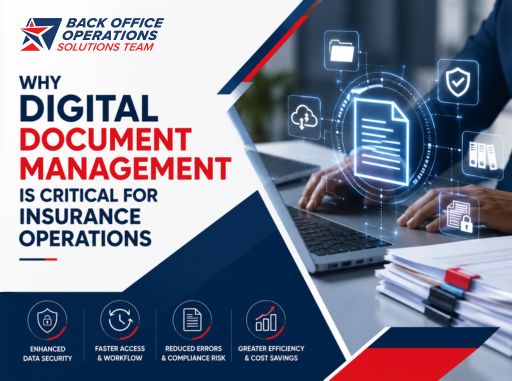
An examiner asks for five years of policy records, and suddenly your team is hunting through shared drives, filing cabinets, and employee inboxes. They are trying to piece together a complete file set that may no longer exist. Missing documents, unclear ownership, and outdated processes turn a routine audit into a costly compliance risk. This is the reality for insurance operations that still rely on fragmented document management. When important records are scattered, every audit becomes a test of what you can find and not a reflection of what you actually have.
Key Takeaways:
- Insurance operations run on documentation, including policies, claims, correspondence, and compliance filings. Paper-based or fragmented systems slow every one of these functions down.
• Digital document management centralizes records so they are searchable, secure, and instantly retrievable.
• Insurance document automation reduces manual errors and frees staff for higher value work.
• Electronic records management supports the retention and accessibility standards regulators require.
• Poor documentation practices directly increase audit risk and claims disputes.
What Digital Document Management Means for Insurance Operations
Digital document management is the practice of capturing, storing, organizing, and retrieving insurance records, policies, endorsements, claims files, and correspondence in a centralized digital system instead of paper files or scattered folders. It covers everything from initial document intake to long-term electronic records management. It is the infrastructure that makes every other part of insurance operations faster and more defensible.
Why Digital Document Management Matters for Insurance Operations
Insurance is a document-heavy business by nature, and regulators treat recordkeeping as a core compliance obligation, not an afterthought. State insurance codes across the country require carriers to maintain complete, readily ascertainable records of policies, claims, and transactions, often for five years or more, and to produce them for examination upon request.
For additional guidance on insurance record retention requirements and regulatory expectations, the National Association of Insurance Commissioners (NAIC) provides resources on insurance regulation, compliance standards, and recordkeeping practices: National Association of Insurance Commissioners (NAIC)
Digital Document Management Impact on Insurance Operations
Function | Paper-Based or Fragmented Systems | Digital Document Management |
Audit record retrieval | Days of manual searching | Minutes with full search and indexing |
Document accuracy | Manual entry errors and misfiled records | Automated capture and consistent indexing |
Compliance retention | Inconsistent and difficult to verify | Structured retention schedules with built-in audit trails |
Staff time on document handling | High and pulled from core work | Minimal and freed for underwriting and service |
Disaster recovery | Vulnerable to loss or damage | Secure, backed up, and accessible anywhere |
Industry Insight: Document Management Challenges in Insurance Operations
Records problems rarely surface until they become expensive. A misfiled endorsement does not cost anything the day it happens. It costs the carrier when a claims dispute depends on exactly what the policy stated at binding, and no one can produce it quickly. Electronic records management does not just organize files. It protects the carrier’s position on the day a document actually matters.
Case Study: Turning an Audit Scramble Into a Non-Event
A regional carrier undergoing a routine market conduct exam found that producing five years of policy and claims records took its internal team nearly three weeks. This pulled staff away from active underwriting work to track down paper files across two office locations.
After digitizing its document intake and shifting to a centralized, indexed electronic records management system, the same type of request was fulfilled in under two days during the following exam cycle, with every record time-stamped and traceable to its original transaction.
Best Practices for Insurance Document Automation
- Digitize documents at the point of intake, not after they have already piled up.
- Standardize indexing and naming conventions across every document type.
- Build retention schedules directly into the system rather than tracking them manually.
- Give underwriters and claims staff searchable access instead of routing every request through one gatekeeper.
Common Insurance Operations Document Management Mistakes
- Treating digitization as a one-time project instead of an ongoing intake process.
- Storing scanned documents without consistent indexing, which simply recreates the paper problem digitally.
- Failing to define retention or destruction schedules, creating unnecessary compliance exposure.
- Relying on individual employees’ inboxes or drives as the “real” record.
Insurance Operations Document Management Checklist
- Can you retrieve any policy or claims record in minutes, not days
- Is your retention schedule built into the system rather than tracked manually?
- Are documents indexed consistently across every function?
- Could you pass an audit request tomorrow without pulling staff away from active work?
Final Thoughts
Strong insurance operations are not built on good intentions about “getting organized eventually.” They are built on systems that capture, index, and secure every document the moment it enters the workflow. That is the back-office infrastructure Boost USA provides.
FAQs:
Why Is Digital Document Management Important for Modern Insurance Operations?
Insurance operations depend on accurate, retrievable records for underwriting, claims, and compliance. Digital document management replaces slow, error-prone paper processes with centralized, searchable systems, reducing risk and freeing staff for higher value work.
How Does Digital Document Management Improve Compliance and Document Accessibility?
It builds retention schedules and audit trails directly into how records are stored so insurance compliance documentation remains current and retrievable. It prevents records from becoming disorganized every time a regulator or auditor requests them.
Make Your Next Insurance Audit a Routine Request, Not a Business Disruption. Act Today!
If your team cannot quickly locate every policy, claim file, and compliance record, your document processes are creating unnecessary risk.
Boost USA helps insurance organizations eliminate fragmented workflows with secure document management solutions that capture, organize, index, and retrieve critical records when they matter most. From document intake to electronic records management, we help carriers build faster, more reliable, and audit-ready insurance operations. Find out where your document workflows are putting your team at risk. Request a free document management assessment from Boost USA today.