The inspector submitted it a few days ago. Somewhere between the field submission and the underwriting desk, it is sitting in a queue, complete, unreviewed, and holding up a decision that should have been made last week.
This is not a staffing issue or an inspection problem. It is an inspection workflow problem that costs insurance operations more than most organizations can calculate.
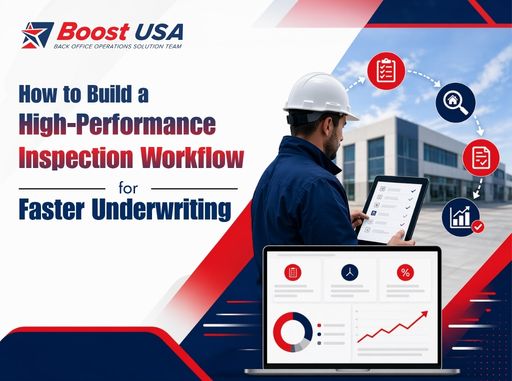
A high performance inspection workflow is not complicated to build. It requires the right structure, the right checkpoints, and the discipline to treat inspection operations as a system. Here is how to build one.
Why Inspection Workflow Efficiency Matters More Than Ever
According to the National Association of Insurance Commissioners (NAIC), accurate documentation, strong internal controls, and consistent reporting standards are essential for improving underwriting accuracy, reducing claims disputes, and maintaining compliance across insurance operations.
Inspection Workflow Bottlenecks and Their Operational Impact
Inspection Workflow Gap | Business Impact |
Delayed report reviews | Slower underwriting turnaround |
Missing inspection details | Increased underwriting rework |
Inconsistent risk ratings | Mispriced policies |
Weak photo documentation | Poor claims defensibility |
No QA checkpoint | More processing errors |
Untracked recommendations | Compliance exposure |
Manual follow ups | Operational inefficiency |
A high performance inspection workflow does more than accelerate underwriting. It improves decision quality, strengthens compliance records, reduces administrative waste, and creates cleaner portfolio level risk intelligence across the organization.
Start With the End in Mind for Better Underwriting Results
Most inspection workflow problems begin at the design stage. Organizations build workflows around what is easiest to manage and easiest to collect in the field, rather than what the underwriting process actually requires to make a confident decision.
Before optimizing anything, answer this clearly: what does an underwriter need from every inspection report to bind, price, and document a risk without follow up?
The answer typically includes specific property condition narratives, photographic evidence tied to documented observations, a justified risk rating, and formal recommendations for every flagged hazard.
When the inspection workflow is built backward from those requirements, every field and every review checkpoint has a purpose. When it is not, inspectors collect data that satisfies a form but not a decision.
The first step in inspection workflow optimization is alignment between field data collection and underwriting requirements.
Standardize Inspection Workflows Before Scaling Operations
One of the most common mistakes in insurance operations is scaling an inspection program before standardizing it.
Volume increases, territories expand, and organizations hire more inspectors, all without addressing the inconsistency already present in their documentation.
The result is a portfolio of inspection reports where the same hazard is described differently across territories, risk ratings mean different things depending on who completed the form, and narratives range from specific and actionable to vague and meaningless.
Standardization fixes this at the source. Structured forms with required fields, clear photo documentation guidance, and consistent risk language across the organization eliminate variance before it enters the system.
When every inspector works from the same standard, quality reviews are faster, data is comparable, and the underwriting process receives inputs it can rely on.
Standardization is not a constraint on inspectors. It is the foundation that makes their work defensible.
Build a Quality Checkpoint Before Underwriting Intake
This is the most impactful structural change that most inspection operations are missing.
When reports move directly from field submission to underwriting intake without a quality review layer, every deficiency becomes embedded in the file. Missing fields, unsupported risk ratings, and vague narratives pass through unchallenged, and the underwriting team either works around them or sends reports back. This adds days to a process that should take hours.
A dedicated QA checkpoint between field submission and underwriting intake changes the dynamic entirely. Every report is reviewed against a documented standard before processing. Deficiencies are caught and corrected before they reach the underwriting desk, and inspectors receive specific feedback that improves their documentation quality over time.
The downstream impact is measurable: faster underwriting turnaround, fewer corrections, cleaner files, and a team that spends its time making decisions rather than chasing information.
A quality checkpoint is not overhead. It is the mechanism that makes every other part of the inspection workflow run faster.
Close the Loop on Every Inspection Recommendation
A high performance inspection workflow does not end when the report is submitted. It ends when every hazard identified in that report has been formally recommended, tracked, and verified as corrected.
Most inspection operations have a significant gap here. Recommendations are issued and then fall through the cracks. Policyholders acknowledge receipt and nothing more. Thirty, sixty, or ninety days pass with no confirmation of whether the hazard was addressed or ignored.
Recommendation management closes this loop. Every hazard is tracked from issuance through policyholder response to verified correction. This turns the inspection workflow into a continuous risk reduction cycle rather than a one time documentation event, with a compliance record that holds up under regulatory scrutiny.
Frequently Asked Questions About Inspection Workflows
What is an inspection workflow in insurance underwriting?
An inspection workflow is the process insurance companies use to collect, review, and deliver inspection data for underwriting decisions. It includes field inspections, report reviews, quality checks, and the tracking of recommendations. A strong workflow helps insurers evaluate risk more accurately and efficiently.
How does an inspection workflow impact underwriting speed and accuracy?
A structured inspection workflow ensures underwriters receive complete and accurate reports without unnecessary delays. This reduces back and forth communication, missing information, and report corrections. As a result, underwriting decisions become faster, more consistent, and more reliable.
What are the key steps in building a high performance inspection workflow?
Building a high performance inspection workflow starts with standardized reporting and clear documentation requirements. It also requires quality assurance checkpoints, consistent communication, and the tracking of recommendations. Together, these steps improve report quality and streamline underwriting operations.
How can automation improve an inspection workflow for faster underwriting?
Automation reduces manual work by speeding up report processing and identifying missing information early. It also improves communication between inspectors, QA teams, and underwriters. This helps insurers process inspections faster while improving accuracy and operational efficiency.
The Inspection Workflow That Protects the Insurance Portfolio
Faster underwriting is not just about speed. It is about receiving the right information, at the right quality, at the right time, consistently across every inspector and every submission.
Boost USA builds the operational infrastructure that enables this. From QA for Loss Control Reports and BoostRM™ Recommendation Management to Guided Self Inspections and Loss Control System Integration, Boost USA supports every stage of the inspection workflow, so your internal team can focus on decisions, not administration. Ready to build an inspection workflow that actually performs? Connect with us today!