You aced the exams, you earned the certifications, and your resume looks perfect on paper. However, when you step into your loss control career in a live commercial facility where real risks unfold in real time, you are hit with a harsh reality.
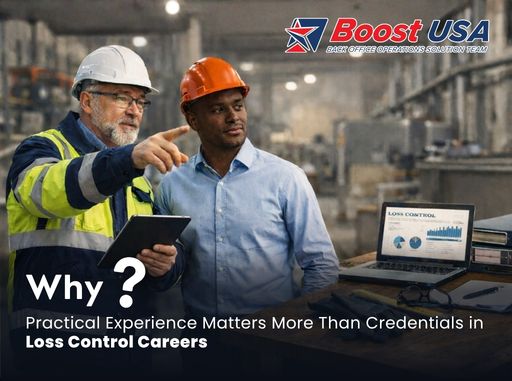
In a loss control career, it is not the credentials that define your capability; it is what you actually see, assess, and act on in the field that sets you apart. What you can actually do matters much more than what you can recite. Hence, the gap between a credentialed professional and a capable one is almost always filled by field experience and not coursework.
The Credential Problem in Loss Control Careers
The insurance industry has a complicated relationship with formal credentials. Loss control job postings routinely list degrees, certifications, and designations among the required qualifications. On paper, this makes sense. The work involves risk assessment, regulatory compliance, building systems, and liability exposure. Surely, a structured academic background supports all of that.
But here is what those job requirements rarely measure: Can you identify a compromised sprinkler system by the way the pipes are pitched? Can you walk a roofline, read the load bearing cues in a decades old steel frame, and know intuitively where the exposure is before you ever open your checklist? Can you earn a business owner’s trust in the first three minutes of a site visit so they show you what is actually wrong, not just what they want you to see?
These are just a few of the essential skills that do not come from a classroom. These skills come from repetition, judgment built over time, and the kind of pattern recognition that only develops when you have walked hundreds of properties and filed hundreds of reports.
What Field Experience Develops in Loss Control Careers
When people with strong practical backgrounds transition into a loss control career as construction professionals, HVAC technicians, safety officers, or fire service veterans, they bring something that credential first candidates often lack. They have a trained eye that has already learned to see risks.
A contractor who has framed commercial buildings understands what deferred maintenance actually costs, not as a theoretical hazard but as a structural reality. An HVAC technician who has serviced aging systems across dozens of facilities knows what “appeared adequate” really means.
This is why practical experience functions as a kind of accelerated inspection training. The field has already taught these professionals how to assess what they are seeing. What remains is learning to document it, frame it for underwriting, and communicate it in a way that yields actionable recommendations rather than vague observations that undermine the report’s value.
Real Job Requirements for a Successful Loss Control Career
The loss control professionals who consistently perform at the highest level tend to share a few qualities that have nothing to do with their academic transcripts. They have sharp observational skills developed through years of hands-on experience. They can write clearly under time pressure. They manage their own schedules without losing accuracy. They treat the insured as a client and a partner, not a subject to be evaluated from a distance.
Those are the real job requirements. Not the ones listed at the top of a posting, but the ones that determine whether a professional produces reports that actually protect a carrier’s book of business or reports that look complete and say very little.
Experience builds the judgment that credentials cannot certify. It builds the confidence to challenge something that looks wrong, even when the checklist suggests moving on. It builds the pattern recognition that turns an inspection from a compliance exercise into a genuine risk intelligence tool.
How Inspection Training Supports Loss Control Careers
None of this means credentials are worthless or that structured learning has no role in a loss control career. It means the sequence matters. Practical experience comes first because it builds the foundation. Structured inspection training then works with that foundation, not as a substitute for it.
This is the model that Boost USA supports through its Loss Control Learning Centre, which provides targeted, accessible training designed for professionals who already bring real world knowledge to the table. The training does not start from zero.
It meets experienced professionals where they are and builds the industry specific language, documentation standards, and reporting frameworks that channel practical expertise into high quality inspection work. The result is a professional who can walk a complex commercial property, see what matters, and produce a report that an underwriter can actually use.
Career Path for Experienced Professionals in Loss Control
If you have spent years in construction, safety, fire service, insurance operations, or any field that requires you to assess real conditions in real environments, a loss control career may already align with the skills you have developed over time.
The credentials will come. The inspection training is structured and easy to learn. The platform to apply what you know is ready. What nobody can give you, and what no certification can replicate, is the experience you already have.
That is what makes you valuable in this field, and that is exactly what the loss control industry needs more of.
Final Thoughts on Loss Control Careers
In the end, a successful loss control career is built in the field and not on paper. Credentials may open the door, but it is your ability to observe, interpret, and act in real world conditions that defines your true value. The professionals who stand out are not those who know the most theory, but those who can translate experience into insight and action. If you bring that practical edge, you are already ahead. Now it is about sharpening it, applying it, and turning it into impact where it matters most.
FAQs on Loss Control Careers
What skills are most important for a successful loss control career?
Strong observation, risk assessment, and clear report writing are critical. Time management, communication, and the ability to spot hidden hazards in real environments matter just as much. Practical judgment developed on site is what truly sets top performers apart.
How does practical experience impact performance in loss control roles?
Practical experience sharpens your ability to identify real risks quickly and accurately. It builds pattern recognition, confidence, and decision making skills that cannot be learned from textbooks. This leads to more accurate inspections and more valuable reports.
Do certifications matter less than field experience in loss control careers?
Certifications still matter, but they play a supporting role. Field experience demonstrates your capability in real world situations, while certifications validate your knowledge. The best professionals combine both, but experience often carries more weight in performance.
How can beginners gain hands-on experience in the loss control industry?
Start by leveraging related fields like construction, safety, HVAC, or insurance operations. Shadow experienced inspectors, take entry level inspection roles, and pursue targeted training programs. Real exposure to properties and risk environments is the fastest way to build skill.
Take the Next Step in Your Loss Control Career!
How Boost USA connects skilled professionals with top tier loss control roles, plus the training and resources you need to stand out and succeed. Take the next step forward with Boost USA.