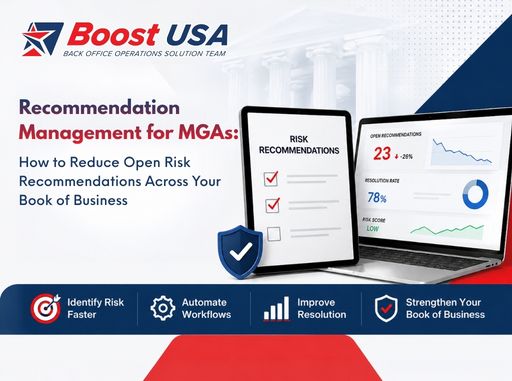
An inspection without follow through is just paperwork. For MGAs managing hundreds or even thousands of policies, open risk recommendations that never get resolved are not a small issue. They quietly chip away at your loss ratios, complicate renewals, and strain carrier relationships. That is why recommendation management is not just important. It is essential.
Think about this. A commercial property inspection is completed. The report flags three issues, a faulty electrical panel, an unsecured storage area, and poor fire suppression coverage. The inspection did exactly what it was supposed to do. But if no one follows through, nothing actually changes.
And that is where things start to break.
For MGAs, this gap is expensive. You are managing large, diverse books across multiple regions, often with lean teams and high expectations from carrier partners. When recommendations are not tracked properly, the impact does not stay small. It builds fast.
Why Open Risk Recommendations Pile Up in MGAs
Most MGA teams are still juggling recommendations across spreadsheets, email threads, and scattered system exports. These tools were not built for ongoing follow ups, reminders, and tracking at scale.
Handling a handful of policies this way might work. But when you are dealing with hundreds or thousands, every recommendation turns into a moving part. It becomes something that needs to be tracked, followed up on, escalated, and documented, often multiple times within a few months.
Without a proper system, the workload does not just grow. It is overwhelming. And when that happens, the most critical items are often the first to slip through.
The Real Cost of Open Risk Recommendations
Every open recommendation is an unresolved risk sitting in your portfolio. It may not seem urgent at the moment, but over time, it affects your loss ratios, increases errors, and weakens your credibility with carriers who expect clear proof of risk mitigation. It is not just about what is open. It is about what that says about your operations.
The Recommendation Management Lifecycle Most MGAs Are Missing
Good recommendation management is not a one time task. It is a process.
A strong system follows a clear lifecycle, from issuing the recommendation to tracking follow ups, escalating when needed, documenting proof, and formally closing the loop with a clean audit trail.
The problem is that most MGAs do not struggle at just one stage. They struggle across several. Follow ups get missed, escalations do not happen, and documentation gets lost.
This is not about people dropping the ball. It is about systems that do not support the process.
What Effective Recommendation Management Looks Like in Practice
The MGAs that get this right have one thing in common. Structure.
Everything lives in one place. Every recommendation is trackable, visible, and easy to manage, with no digging through inboxes or chasing updates across tools.
At the start, each recommendation is logged with clear details, including deadlines, hazard type, and contact information. But too often, this step is handled loosely, with no unique ID or ownership, which makes accountability difficult from day one.
By day 30, follow ups should happen automatically. In reality, many teams still rely on someone to remember to send an email, leading to inconsistency and delays.
By day 45, anything unresolved should trigger escalation. But without a built in system, many of these items just sit there, untouched.
When documentation comes in, such as photos, invoices, or certificates, it should be tied directly to the recommendation. Instead, it often gets buried in email threads, disconnected from the original record.
And finally, closure should be formal and documented. But in many cases, items are simply marked as done without any real proof or reporting, leaving gaps when they matter most.
What Carrier Partners Expect from MGA Recommendation Compliance
From a carrier perspective, it is simple.
They want to see that recommendations were issued correctly, consistently followed up on, and resolved before renewal. No scrambling. No guesswork. Just clear, documented proof.
When that is in place, everything runs more smoothly.
Why Recommendation Management Matters More Than You Think
Strong recommendation management is not just about avoiding risk. It is a growth lever.
MGAs that consistently close recommendations build stronger trust with carriers. That trust translates into better renewal terms, stronger relationships, and more opportunities to grow.
On the other hand, a backlog of open recommendations raises questions about discipline, visibility, and control. Those questions can be difficult to overcome.
In the end, the data speaks before you do.
How Boost USA Improves Recommendation Management at Scale
This is exactly the gap BoostRM™ was designed to fill.
Instead of adding more work to your team, Boost USA handles the entire recommendation lifecycle for you, from tracking and follow ups to documentation, escalation, and reporting.
Everything is centralized. Reminders go out automatically. Documentation is organized and easy to access. High risk items are flagged before they turn into problems. You also get a clear, real time view of everything without chasing updates.
Whether you are managing a few hundred recommendations or a few thousand, the system scales with you, so nothing gets missed.
For MGAs that need to show real discipline and consistency to carrier partners, BoostRM™ provides the structure to make it happen without adding headcount.
Final Thoughts on Recommendation Management for MGAs
Recommendation management is not just a task in the background. It is a reflection of how well your business actually runs. MGAs that move beyond spreadsheets and build structured systems do not just stay compliant. They operate with confidence. In a market where trust and performance matter, that makes all the difference.
FAQs:
What is recommendation management in insurance for MGAs?
It is the process of tracking, following up, documenting, and closing risk recommendations identified during inspections to ensure hazards are resolved and compliance is maintained.
Why do MGAs struggle with open risk recommendations across policies?
They often rely on manual tools like spreadsheets and emails, which cannot handle high volumes, leading to missed follow ups, poor tracking, and lack of accountability.
How does effective recommendation management improve underwriting performance?
It reduces unresolved risks, improves loss ratios, strengthens compliance records, and builds greater trust with carrier partners.
What systems or processes help MGAs track and close risk recommendations efficiently?
Centralized platforms with automated follow ups, escalation triggers, structured documentation, and real time visibility help manage and close recommendations efficiently.
Stop Managing Recommendations in Spreadsheets! Get in Touch With Us Today!
If your team is still chasing updates across emails and spreadsheets, it is time for a better way. BoostRM™ handles tracking, follow ups, documentation, and reporting, so your team can focus on growing the business rather than managing paperwork. Get in touch today.