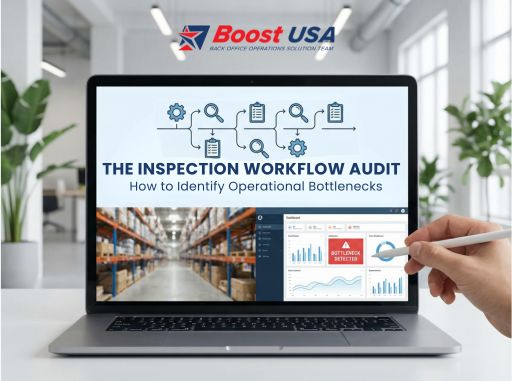
Do you know that there is a version of your insurance inspection operations that runs smoothly? Reports arrive on time, recommendations are tracked and closed, underwriters receive exactly what they need, and your inspection team does not get buried in follow up emails by 9 AM. Most carriers and loss control firms never reach that point because no one stops to examine where the workflow actually breaks. That is exactly what an inspection workflow audit is designed to uncover.
What Is Being Audited in an Insurance Inspection Workflow
An insurance inspection workflow is not limited to the field visit. It includes every stage from order assignment to report delivery, quality assurance review, recommendation issuance, and closure tracking. The bottleneck is rarely the inspector’s inefficiency. Instead, delays typically occur at the points where work passes from one step to another or from one team to another. These handoff moments are where tasks stall, information gets lost, or work becomes duplicated.
A comprehensive audit maps every stage of the process. Most workflows revolve around four core operational areas:
- Scheduling and assignment
- Report processing
- Recommendation management
- Compliance documentation
Understanding how these areas interact is critical to maintaining operational efficiency in loss control programs.
Industry research frequently emphasizes the importance of operational efficiency and process visibility in insurance operations. Organizations such as the Insurance Information Institute highlight that effective risk management processes rely heavily on accurate inspection data and streamlined reporting structures.
Where Insurance Inspection Workflows Break and Why No One Notices Until It Is Too Late
Scheduling Gaps That Lead to Inspection Delays
When inspections are assigned without territory based logic, inspectors often end up traveling across coverage areas. Travel time begins to consume capacity, and inspection orders age before anyone realizes the assignment was inefficient.
A single mismanaged territory can create ripple effects across multiple accounts. Teams that rely on spreadsheets and long email chains to manage assignments operate with hidden operational risk. In many cases, one staffing change or unexpected absence can disrupt the entire process.
Report Intake Without Quality Control
Inspection reports typically arrive in batches. Without a well structured quality assurance layer, incomplete or inconsistent reports cannot move forward efficiently. Even worse, errors may remain hidden until underwriting review or claim evaluation.
This is why structured QA processes are critical. At Boost USA, quality assurance for loss control reports is treated as a dedicated operational function rather than an afterthought. A single inaccurate report can quickly compound into underwriting errors or compliance gaps.
Recommendation Tracking That Lives in Someone’s Inbox
Recommendation management is one of the most common operational bottlenecks. When recommendations sit in email inboxes without a structured follow up cycle, insurers face compliance exposure, dissatisfied policyholders, and underwriting decisions based on outdated information.
Decentralized tracking systems almost always lead to inconsistent follow up and missed closures.
Back Office Tasks Consuming Field Team Capacity
Experienced loss control consultants and territory managers should focus on risk analysis and inspection expertise. When these professionals spend hours confirming schedules, entering data, or chasing missing report fields, productivity drops and operational costs increase without improving inspection quality.
Operational efficiency research consistently shows that process automation and workflow support dramatically improve productivity across administrative heavy operations. For example, insights from McKinsey & Company highlight how structured operational workflows can significantly reduce administrative burden and improve productivity across complex service operations.
How to Conduct an Insurance Inspection Workflow Audit
Conducting a workflow audit begins with measuring cycle time.
Start by analyzing key operational metrics:
- How long does an inspection order take from assignment to delivered report?
- How long does it take to move from report delivery to recommendation issuance?
- How long does it take for recommendations to reach confirmed closure?
If these metrics are not currently tracked, that absence is the first operational finding.
Next, speak directly with the people performing the work rather than relying only on management insights. The individual processing reports late in the afternoon often understands exactly where the workflow slows down. Inspectors who repeatedly receive assignments outside their territory also see operational inefficiencies firsthand.
The next step is workflow mapping. Identify where work pauses, where human intervention is required, and where manual communication replaces what could be automated through system integration.
Finally, evaluate your operational support model. Many insurers unintentionally allocate highly compensated consultant resources to administrative tasks. In many cases, insurance back office outsourcing resolves these inefficiencies while maintaining or even improving operational output.
What an Optimized Insurance Inspection Workflow Looks Like
When audit findings are consistently addressed, operational improvements become immediately visible.
Inspection orders move through assignment using clear territory logic. Reports pass through a consistent quality assurance review before reaching underwriting teams. Recommendations are tracked through centralized systems with automated follow up cycles. Most importantly, internal experts focus on loss control strategy rather than administrative logistics.
This is the operational model that Boost USA is designed to support. The company provides full service operational support covering territory manager assistance, guided self inspections, recommendation management, and loss control system integration.
Rather than offering a partial solution, the model integrates directly into existing insurance operations to remove inefficiencies that quietly impact time, accuracy, and operational cost.
Frequently Asked Questions About Insurance Inspection Workflows
What Is an Insurance Inspection Workflow and Why Is It Important?
An insurance inspection workflow is the step by step operational process used to schedule inspections, collect risk data, prepare reports, and issue recommendations. It is important because it ensures inspections are conducted consistently, risks are documented accurately, and insurers can make informed underwriting and loss control decisions.
How Can an Insurance Inspection Audit Help Identify Operational Bottlenecks?
An inspection audit reviews each stage of the workflow to identify delays, duplicated tasks, and communication breakdowns. By analyzing these operational stages, insurers can locate inefficiencies that slow inspection reporting, risk evaluation, and compliance tracking.
What Are the Common Challenges in Managing Insurance Inspection Processes?
Common challenges include delayed report submissions, manual data entry, weak coordination between inspectors and administrative teams, and limited visibility into recommendation compliance. These issues frequently result in slower operational decisions and increased administrative burden.
How Can Insurers Improve Efficiency in Their Insurance Inspection Workflow?
Insurers can improve workflow efficiency by standardizing inspection procedures, automating report intake processes, improving communication between operational teams, and using dedicated administrative support to manage inspection logistics and documentation.
Fix Insurance Inspection Workflow Bottlenecks Before They Lead to Claims! Get in touch With Us!
Every inspection workflow eventually reaches a breaking point. A structured audit reveals where that point exists before operational issues escalate into underwriting errors or claim exposure. If you are ready to stop managing bottlenecks and start eliminating them, connect with Boost USA today and explore our Loss Control Inspection and Recommendation Support services.