
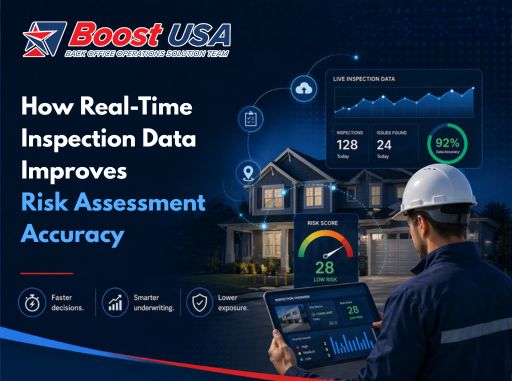
Underwriting decisions are only as good as the inspection data behind them. Data that arrives late, incomplete, or inconsistent erodes the accuracy of risk assessment.
The inspection report sitting in your queue right now was probably scheduled days ago, completed yesterday, and will reach an underwriter sometime this week. By then, the property conditions it describes may already have changed. A business may have expanded its operations.
A roof repair may have been left incomplete. A new hazard may have been introduced after the inspection. When inspection data is stale before it is ever acted upon, risk assessment accuracy suffers, and the loss ratio eventually tells the story.
This is the foundational and commonly occurring problem that real time inspection data solves. It is also reshaping how the most competitive carriers, MGAs, and risk management firms approach the entire underwriting lifecycle.
The True Cost of Delayed Inspection Data in Underwriting
Static, after the fact inspection reporting was never a precision instrument. It was a documentation exercise that is useful for compliance, but limited as a risk intelligence tool. The gaps it creates are well documented.
Underwriters using delayed inspection data make pricing decisions based on conditions that no longer exist. A property inspected 30 days ago and reviewed today carries a compounding margin of uncertainty with every passing day of delay. Multiply that across hundreds of inspections per month, and the aggregate exposure is substantial.
According to McKinsey and Company, insurers that leverage advanced analytics and real time data inputs achieve up to 40 percent better underwriting accuracy than those relying solely on static historical records. The gap is structural, and it starts at the inspection data layer.
What Real Time Inspection Data Changes in Risk Assessment
When inspection data flows in real time, with photos uploaded from the field, reports generated on site, and flags automatically triggered for missing documentation or identified hazards, the underwriting function gains something it rarely has current ground truth.
This changes the accuracy of risk assessment in four meaningful ways.
Hazard identification happens before exposure, not after:
Traditional inspection workflows surface risks after the inspection, after the report is compiled, and after it clears a review queue. Real time inspection data compresses that window dramatically. When a field inspector flags a structural deficiency and that flag reaches the underwriting desk within hours rather than weeks, the carrier can act before a claim event, not in response to one.
Underwriting data insights become actionable, not archival:
Inspection reports that arrive days after the field visit are used to document what was observed. Real time inspection data is used to inform next steps. That shift from documentation to decision support is where underwriting data insights generate actual value.
A Willis Towers Watson study found that carriers implementing data driven underwriting processes experienced a 67% improvement in risk assessment accuracy and a measurable decrease in combined ratios.
Incomplete data gets corrected at the source, not discovered downstream:
One of the most persistent sources of risk assessment error is incomplete inspection data missing photographs, unverified occupancy details, and vague condition descriptions. When quality assurance is embedded in the real time data flow, it flags deficiencies before a report is submitted. Field errors are corrected at the lowest cost. Downstream rework, re inspections, and underwriting decisions made on partial data are all reduced simultaneously.
Portfolio level patterns become visible:
Individual inspections capture single property conditions. Real time inspection data, aggregated across a portfolio, surfaces systemic patterns such as property types that consistently produce incomplete submissions, territories with elevated hazard rates, and inspectors whose reports require systematic correction. This portfolio visibility transforms inspection data from a transactional record into a strategic risk management input. This is the kind of insight that informs underwriting guidelines, not just individual policy decisions.
Why Integration Is Critical for Real Time Inspection Data
The technical capability for real time inspection data exists. The operational infrastructure to capture, validate, and route that data accurately at scale is where most programs fall short.
The National Association of Insurance Commissioners has consistently identified data accuracy and timeliness as foundational requirements for sound underwriting practice. Yet most carriers still manage inspection workflows through fragmented systems, manual handoffs, and review processes that introduce delays at every stage.
Seamless integration of loss control systems, connecting field inspection tools, quality assurance workflows, and underwriting platforms into a unified data pipeline, is the operational prerequisite for real time inspection data to deliver on its promise. Without that integration layer, faster field data collection simply creates a faster path to the same bottlenecks.
Final Thoughts on Real Time Inspection Data and Underwriting Accuracy
At its core, underwriting is a timing game as much as it is a data game, and delayed data is simply risk disguised as insight. Real time inspection data closes that gap by turning field observations into immediate, actionable intelligence rather than outdated records.
The carriers that win are not the ones collecting more data, but the ones acting on the right data at the right moment. In an environment where risk evolves daily, relying on yesterday’s conditions to price today’s policies is no longer sustainable. Build a system where inspection data moves as fast as the risk itself, and accuracy stops being a challenge and becomes your competitive edge.
FAQs on Real Time Inspection Data and Risk Assessment Accuracy
How does real time inspection data improve risk assessment accuracy in underwriting?
Real time inspection data provides current on the ground conditions rather than outdated reports. This reduces uncertainty and helps underwriters evaluate risks more accurately. It also enables faster action on hazards before they turn into claims.
What challenges do insurers face without access to real time inspection data?
Insurers rely on delayed data that may no longer reflect actual property conditions. This leads to inaccurate pricing, missed risks, and flawed underwriting decisions. Over time, it increases loss exposure and impacts profitability.
How can real time inspection data enhance decision making across underwriting workflows?
It transforms inspection reports into immediate, actionable insights rather than static records. Underwriters can make faster, more informed decisions with fewer data gaps. It also improves coordination between field teams, quality assurance, and underwriting.
What technologies enable faster collection and processing of inspection data?
Technologies like mobile inspection applications, cloud based platforms, automated quality assurance systems, and real time integrations make this possible. They ensure instant data capture, validation, and sharing. This creates a seamless flow from field inspection to underwriting decision.
Turn Inspection Data Into Underwriting Intelligence With Boost USA
Boost USA’s Loss Control System Integration service is built precisely for this challenge. We help insurance carriers, MGAs, and risk management firms connect their inspection workflows end to end from field data capture and automated quality assurance to platform integration with systems like LC360 so that inspection data reaches underwriters accurately, completely, and on time.
Our SOC 2 and ISO 27001 certified infrastructure ensures every data point moving through your inspection pipeline meets the security and compliance standards the industry demands. Combined with our quality assurance for Loss Control Reports service, we add a multi layer review that maintains high data quality as inspection volume scales.
The result is not just faster reporting. It is risk assessment accuracy built on inspection data you can actually trust. Ready to close the gap between field inspection and underwriting decision? Get in touch with us today.