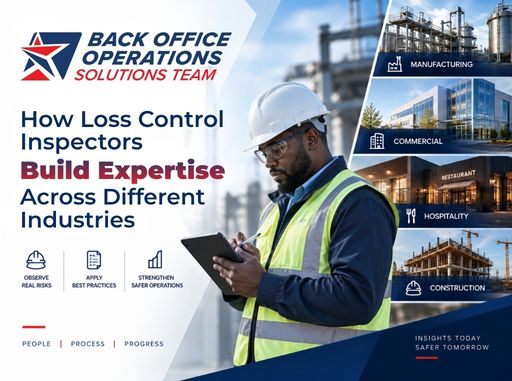
What if the career you are building today could train you to see risks that most people never notice? A successful loss control career is built on learning to see risks before they become costly problems. A skilled loss control inspector knows how to spot an overloaded electrical panel before it becomes a fire, recognise the conditions that can turn a minor leak into major water damage, and identify hazards that could affect both people and property.
That level of judgment is not something you are born with. You build it through experience, training, curiosity, and exposure to different types of risks.
Key Takeaways:
- Expertise grows across risk types, not inside just one.
- Your trade background is a head start, not a ceiling.
- Every new risk you master opens more loss control inspector jobs.
- Sharp reports matter as much as sharp eyes.
- The right support shortens the learning curve.
What Expertise Really Means in a Loss Control Career
A loss control specialist reads risk one building can show property, liability, workers’ compensation, and construction exposures, and each looks different up close.
- Property risk: fire, water, roofs, and electrical systems.
- Liability risk: premises conditions and daily operations.
- Workers’ comp risk: how people really do their jobs.
- Construction risk: sites that change every week.
The range across these is what separates a one-trick inspector from the one carrier’s request by name. Master one. Then add the next.
Why Multi-Risk Skills Pay Off in a Loss Control Career
Carriers, MGAs, and MGUs rarely need just one kind of survey. A loss control professional who can move from a restaurant to a machine shop to an active job site gets the call first.
The wider market points the same way. The Bureau of Labor Statistics projects 19% growth for occupational health and safety specialists and technicians from 2025 to 2035, with about 20,900 openings a year. It’s a neighboring field, but it signals real momentum for insurance inspection careers.
Add one more skill to your toolkit, and you become harder to replace. That’s the quiet power of a well-rounded loss control career.
Risk Type | Property Risk | Construction Risk | Workers’ Comp Risk |
What You Inspect | Roofs, electrical systems, sprinklers, water and fire exposures | Active job sites, subcontractor practices, and site controls | Work processes, safety practices, and injury exposures |
Key Skill | Spotting building system weaknesses | Reading fast changing conditions | Observing how people actually work |
Strong Fit Background | HVAC, fire protection, general contracting | Contractors, tradespeople, site supervisors | Safety officers, risk managers, military |
Typical Next Step | Add liability or hospitality surveys | Add property surveys | Add manufacturing or warehouse risk |
Why it works for a loss control career: Each risk type develops a different set of inspection skills. Starting with an area that matches your existing experience can help you build expertise and expand into additional survey types over time.
How Inspectors Build Loss Control Expertise Step by Step
So how do you best do it? Five moves.
- Start where you’re strongest: A contractor knows building systems. An HVAC tech knows mechanical risk. Lead with that.
- Add one adjacent risk at a time: Move from construction to property, then to hospitality or manufacturing. Small steps in this career compound.
- Write like it matters: Your report is your product. Clear, specific findings earn underwriter trust fast.
- Stack credentials: Certifications like CSP or ARM signal commitment and help when you compete for risk inspection careers.
Ask why. Don’t just log a hazard. Understand how it turns into a claim.
A Quick Illustration of Loss Control Career Growth
Picture a former general contractor who starts with construction inspections. Six months in, adds warehouse property surveys and learns to spot sprinkler and electrical gaps. By month twelve, covers restaurants and light manufacturing too.
Skills didn’t change overnight. range did, and assignment volume followed. That is how a loss control career compounds.
Mistakes That Slow Loss Control Careers Down
Progress stalls in predictable ways:
- Chasing every risk type at once
- Treating reports as paperwork
- Copying checklists without understanding them
- Going solo with no mentor or network
Avoid these, and your loss control career moves faster.
Your Next 30 Days Checklist for a Loss Control Career
- Pick one risk type close to your background.
- Review three sample reports and note what makes them clear.
- Choose one credential to research.
- Join a network of working inspectors.
How Boost USA Helps Build a Loss Control Career
You don’t have to figure this out alone. Boost USA connects qualified professionals with carriers, MGAs, and MGUs nationwide, with no placement fees.
Territory managers coordinate assignments and scheduling. A professional network keeps you connected. And the free Loss Control Learning Center gives you structured resources to grow across risk types.
Boost USA notes that committed inspectors can earn $100,000 or more. It’s a running start for any new loss control career.
Final Thoughts
Expertise in loss control isn’t a talent. It’s a habit: learn a risk, apply it, add another. Do that consistently, and a loss control career stops being something you chase and starts finding you.
FAQs:
What Is Recommendation Management in Insurance?
It is the process of tracking loss control recommendations from issuance to verified closure, with reminders, escalation, and documentation.
Why Prioritize Recommendations?
Because hazards differ in loss potential. Prioritization puts limited team time on the loss control recommendations most likely to become claims.
How Does Recommendation Tracking Help With Loss Control Compliance?
Recommendation tracking creates a centralized record of open items, assigned owners, deadlines, follow ups, and completed corrective actions. This gives insurance teams greater visibility into outstanding risks and helps them confirm that recommendations have been addressed.
What Should Be Included in a Recommendation Follow Up Process?
A recommendation follow up process should include a clearly assigned owner, a target completion date, scheduled reminders, escalation for overdue items, and documentation confirming that the corrective action has been completed. This creates a consistent process from initial inspection through verified closure.
Can Recommendation Management Be Outsourced?
Yes. Insurance carriers, MGAs, and MGUs can outsource recommendation management to specialized providers that track recommendations, manage follow ups, document closure, and provide exception reporting while working within existing insurance workflows.
Ready to Build Expertise That Pays?
Your experience already counts. Now put it to work. Explore Boost USA’s Become a Loss Control Inspector program and start building a loss control career with real range, real support, and real demand. Territories fill fast. Claim yours before someone else does. Get in touch with us today.