A property inspector flags a corroded sprinkler riser at a distribution centre and documents it. The report goes out. A reminder gets sent once. Then the item sits not because anyone decided it was not important, but because nothing was tracking it. After three renewal cycles, the same finding shows up again, and no one can say whether it was ever addressed. This is where Recommendation Management becomes important. It helps insurance teams track recommendations from the initial finding through follow-up, resolution, and closure.
Key Takeaways
- An untracked recommendation is an open action item, not a closed file, and open items left unmanaged tend to stay open.
- Structured recommendation management assigns ownership, deadlines, and status to every item the moment it is issued.
- Visibility, not just documentation, is what keeps actions from stalling.
- Automated reminders and exception reporting replace dependence on manual follow-up.
- Verified closure, not a sent letter, is what actually resolves a recommendation.
What Keeps a Loss Control Action “On Track”
Recommendation management is the discipline of moving a loss control finding from issuance to documented, verified resolution. “On track” means the item’s status is always knowable: open, in progress, overdue, or closed with evidence. Without that structure, a recommendation isn’t wrong; it’s just invisible. It remains buried in an inbox until someone happens to look for it.
Why Loss Control Recommendations Stall
Recommendations rarely fail because a policyholder refuses to act. They stall because no system enforces the next step. Recommendation tracking managed manually holds up reasonably well at low volume, but once a book carries hundreds of open items, each with its own deadline and reminder cycle, something slips.
This is a compliance tracking insurance problem as much as an operational one: unresolved hazards translate directly into preventable claims and, over time, deteriorating loss ratios.
Electrical issues alone illustrate the stakes. NFPA research on home fires caused by electrical failure or malfunction shows that electrical failures or malfunctions contributed to 13% of U.S. home structure fires during 2015–2019. This is exactly the category of finding loss control inspections designed to identify before it becomes a claim.
Tracking Starts With an Accurate Report
A recommendation can only be tracked correctly if it was captured correctly in the first place. If an inspector’s report understates a hazard or a form field doesn’t match the photo evidence, the recommendation built on it starts from the wrong baseline, no matter how well it’s tracked afterwards. This is where AI-powered QA fits into the risk mitigation workflow.
It cross-checks every form field against the inspection photos before a report reaches underwriting, flagging missed or misreported damage so the recommendations issued reflect the property as it actually is. The same discipline applies when a policyholder submits closure evidence: a quick verification pass confirms the documentation supports the fix before an item gets marked resolved.
Structured Recommendation Tracking Creates Accountability
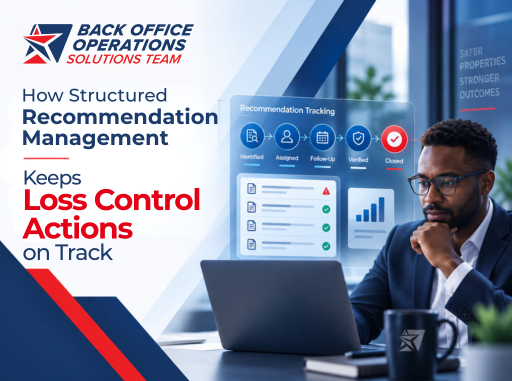
Structured recommendation tracking gives every loss control action a defined place in the workflow. Each recommendation can be assigned to an owner, given a deadline, and monitored through a clear status such as open, in progress, overdue, or closed. This creates visibility into what needs attention without requiring staff to search through emails, spreadsheets, or individual files.
The value is not simply having another record of the recommendation. The process creates accountability around what happens next. Automated reminders can prompt action before a deadline is missed, while exception reporting can bring overdue or unresolved items to the appropriate team’s attention.
This allows insurance teams to proactively address outstanding recommendations rather than discovering them only during an audit, renewal, or later inspection. Closure can also require supporting evidence, helping ensure that an item is not considered resolved simply because correspondence was sent.
For insurance teams managing a growing portfolio, this structure provides a consistent way to move recommendations from the original inspection finding through follow-up and documented resolution. Instead of relying on individual memory or manual searches, the workflow keeps each action’s status visible.
A Familiar Scenario
An MGA managing loss control for a mid-size commercial book runs fine with a shared spreadsheet at 60 open recommendations. At 600, the same spreadsheet becomes a liability: no one can confidently say which items are current, which are overdue, or which were closed based on a letter alone rather than verified evidence. That’s the exact point where recommendation management needs to become a designed workflow, not a habit.
Best Practices for Recommendation Follow-Up
- Assign a unique identifier, owner, and deadline to every recommendation at intake.
- Set reminder intervals, commonly 30 and 45 days, rather than relying on staff memory.
- Require documented evidence, photos, invoices, certificates, before marking anything closed.
- Review exception reports on a regular cadence, not just at renewal.
Common Mistakes That Take Actions Off Track
- Closing a recommendation because a letter was sent, not because the fix was verified.
- Letting documentation live in individual inboxes instead of one shared record.
- Treating every recommendation as equal priority, regardless of hazard severity.
- Discovering overdue items only when an audit or renewal forces the question.
Quick Checklist: Is Your Process Actually Tracking Actions?
- Can you name every open recommendation right now without searching?
- Is each item assigned to a specific owner and deadline?
- Would an audit request take minutes to fulfil, or days?
- Is closure based on evidence, not correspondence?
How BoostRM℠ Helps
BoostRM℠ centralizes intake the moment an inspection closes, sends automated reminders at 30 and 45 days, escalates overdue items without manual prompting, and requires verified evidence before marking any recommendation resolved. Paired with AI-powered QA on the front end, that means both the report a recommendation comes from and the tracking that follows it are held to the same standard.
Final Thoughts
Recommendation management does not break down because teams stop caring about compliance. It breaks down because most operations never build a structure that keeps items visible once the initial letter goes out. Fixing that isn’t about working harder. It is about designing a workflow where nothing depends on someone remembering.
FAQs
What does “structured” recommendation management actually mean?
It means every recommendation has a defined owner, deadline, and status from issuance through verified closure. This creates clear accountability and keeps each action visible throughout the workflow. Instead of existing only as a one time letter, every recommendation remains actively tracked until resolved.
How often should reminders go out?
Most programs use 30 and 45 day intervals to keep outstanding recommendations moving forward. Automatic escalation can be used when deadlines pass without a documented response or resolution.This reduces reliance on staff memory and helps teams proactively address overdue actions.
Does this apply to MGAs and MGUs, or only carriers?
It applies to carriers, MGAs, and MGUs managing ongoing loss control recommendations. As the number of open items grows, the same tracking challenges can occur across different insurance operations. A structured process helps maintain visibility and accountability even when recommendation volumes increase.
Ready to see where your recommendation tracking is losing visibility?
Schedule a portfolio review with Boost USA to identify gaps, follow up on outstanding recommendations, and improve accountability across your workflow. See how BoostRM℠ keeps every action visible and accountable from initial issuance through follow-up, resolution, and final closure, helping your team maintain a clearer view of open recommendations across the portfolio.