An inspector walks through a warehouse, flags an overloaded electrical panel, and writes it up. The report gets emailed to the policyholder. Then, in most operations, nothing happens not because the hazard is not real, but because no one built a process to make sure it gets fixed. This is not a training problem or a staffing problem. It is a design problem that MGAs, MGUs and carriers need to solve.
Key Takeaways
- Recommendation management breaks down not because of a lack of effort, but because of poor process design.
- Manual tracking works up to roughly 50 open recommendations, then begins to collapse.
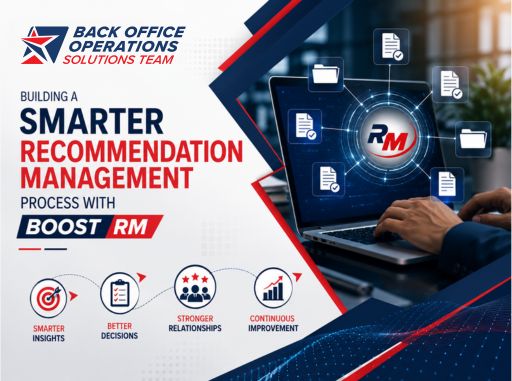
- A smarter process centralizes intake, prioritizes by risk, and requires verified closure.
- Automated reminders and exception reports eliminate reliance on individual memory.
- BoostRM turns recommendation tracking into an underwriting asset rather than an afterthought.
What Recommendation Management Actually Means
Recommendation management is the discipline of tracking every loss control recommendation from the moment it is issued through documented, verified resolution. It is easy to describe but difficult to execute at scale because it is not a single task. It consists of dozens of small tasks repeated across every open file: logging the recommendation, sending it, following up, collecting evidence, confirming the fix, and closing the loop.
Good recommendation management software exists precisely because spreadsheets cannot manage that many moving parts without something slipping through the cracks.
Why Recommendation Management Matters More Than Most Teams Realize
Every unresolved recommendation represents an unresolved hazard, and unresolved hazards are where preventable claims originate. When recommendation tracking is weak, the damage rarely appears as one clear line item. Instead, it appears as recommendations buried in email threads, managers who cannot determine what is still open, and underwriters renewing policies based on assumptions rather than confirmed conditions.
This is an insurance compliance workflow failure, not just an inconvenience. It is exactly the type of exposure that turns audits into scrambles.
Recommendation Management Process Comparison
Function | Without a Built Process | With a Smarter Process (BoostRM℠) |
Recommendation intake | Scattered across email, shared drives, and spreadsheets | Centralized in one system at the time of inspection |
Prioritization | Treated uniformly regardless of severity | Risk based 30, 60, and 90 day cycles by hazard level |
Follow up | Depends on someone remembering | Automated reminders at 30 and 45 days |
Visibility | Overdue items surface after the fact | Exception reports proactively flag risk |
Closure | Assumed once a letter goes out | Requires documented, verified evidence |
Audit retrieval | Days | Minutes |
A Familiar Recommendation Management Scenario
Picture regional MGAs and MGUs managing loss control for a growing book of commercial risks. At 40 open recommendations, a shared spreadsheet works reasonably well. At 400, it does not. Reminders get missed, evidence gets lost in inboxes, and by renewal season, no one can confidently say which hazards were actually corrected.
This is the exact inflection point where manual recommendation tracking reaches its limit. It is also why forward-thinking MGAs and MGUs separate that administrative workload from underwriting rather than asking underwriters to chase paperwork.
Best Practices for Building an Effective Recommendation Management Process
- Assign every recommendation a unique identifier and a deadline the moment it is created.
- Sort recommendations by severity first. A faulty electrical panel should not be delayed behind a missing fire extinguisher tag.
- Automate reminders instead of relying on manual staff follow up.
- Require evidence such as photos, invoices, or certificates before marking any recommendation as resolved.
- Review exception reports weekly instead of waiting until renewal.
Common Recommendation Management Mistakes That Undermine Tracking
- Treating every recommendation as an equal priority regardless of hazard severity.
- Closing items based on a letter being sent rather than confirmed corrective action.
- Allowing documentation to remain in individual inboxes instead of a shared system.
- Waiting until renewal to review what is still open.
Signs Your Recommendation Management Process Needs Rebuilding
- You cannot determine how many recommendations are currently open without searching multiple inboxes.
- Audit requests take days to fulfill instead of minutes.
- Closure is based on a letter being sent rather than evidence being reviewed.
- Your open recommendation count is trending upward instead of downward.
Final Thoughts
Recommendation management does not fail because inspectors miss hazards or teams do not care about compliance. It fails because most organizations never treat it as a process worth designing. Instead, they treat it as paperwork that happens after the real work of inspection is complete. That mindset is exactly what allows a faulty electrical panel or an unguarded machine to remain unresolved for months.
The solution is not asking an already stretched team to be more diligent. It is creating a structure that does not depend on anyone remembering: centralized intake, risk-based prioritization, automated follow up, and closure that requires proof rather than simply a sent letter. Get that architecture right, and recommendation tracking stops being a hidden liability affecting your loss ratio and starts doing what it was always intended to do: turning an identified risk into a resolved risk before it becomes a claim.
FAQs
How is BoostRM℠ different from a spreadsheet?
It replaces manual tracking with automated reminders, exception reporting, and the requirement for documented evidence before closure. It is built for portfolios where spreadsheets begin to fail.
Does this require replacing our current systems?
No. BoostRM℠ integrates with the platforms you already use, including LC360.
Who benefits most from structured recommendation management?
Insurers, MGAs, MGUs, and risk management firms managing more than roughly 50 active recommendations at one time are the primary beneficiaries of structured recommendation management.
Ready to Rebuild Your Recommendation Management Process? Get in Touch With Us Today!
A smarter recommendation management process does not begin with new software. It begins by identifying where your current process breaks down. Schedule a portfolio review and discover exactly how BoostRM℠ closes the loop between inspection and verified corrective action.