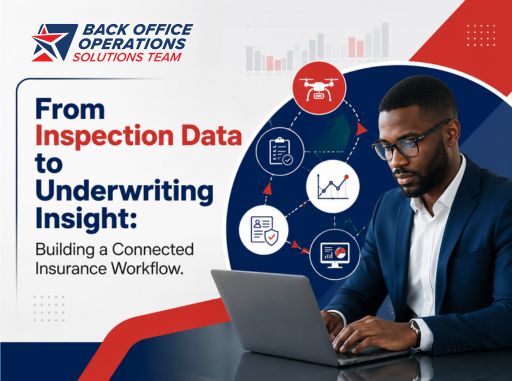
Delays in inspection reports lead to missed underwriting opportunities. In today’s insurance market, the challenge is not collecting risk data but delivering it to underwriters quickly. Disconnected systems and manual processes delay critical decisions, increase operational risk, and slow renewals. Building a connected insurance workflow transforms inspection data into timely underwriting intelligence for faster, more informed decisions.
Most carriers do not have a data problem. They have a connection problem. Inspection reports get filed. Photos get uploaded. Recommendations get issued. Then all of it sits in a portal, an inbox, or a shared drive, waiting for someone to manually move it into the system where an underwriter can actually use it.
That gap is where good risk intelligence goes to die. An inspector can flag a failing roof or an unguarded loading dock with complete accuracy, but if that finding takes three weeks to reach underwriting in a usable format, the insight arrives too late to influence the renewal decision it was meant to inform.
Building a connected insurance workflow means closing that gap structurally, not just procedurally.
Why Disconnected Data Weakens an Insurance Workflow
An underwriting workflow is only as effective as the data feeding it. When inspection data integration is manual, three things consistently happen: recommendations lose their urgency in transit, formatting inconsistencies force underwriters to reinterpret findings instead of acting on them, and renewal timelines slip because no one can confirm whether a prior year hazard was actually corrected.
None of this is really an inspection quality problem. It is a workflow architecture problem. The inspection was accurate. The system around it was not built to carry that accuracy through to the point of decision.
What a Connected Insurance Workflow Really Means
A connected insurance system is not just software that talks to other software. It is a workflow where three things happen without manual intervention: inspection findings are routed directly into the underwriting file in a standardized format, recommendation statuses update automatically as items are closed or escalated, and QA reviews occur before data reaches underwriting, not after problems surface at renewal.
Insurance process optimization built on that foundation changes what underwriting insight actually means. Instead of relying on a static snapshot from months ago, underwriters work with current, verified risk conditions.
The Practical Benefits of a Connected Insurance Workflow
Workflow Element | Disconnected Process | Connected Process |
Inspection to file turnaround | Days to weeks, manual entry | Near real time, automated routing |
Recommendation tracking | Email threads, spreadsheets | Centralized dashboard, automated reminders |
Data format at underwriting | Inconsistent, requires reinterpretation | Standardized, decision ready |
Visibility into open items | Reactive, discovered at renewal | Proactive, exception flagged |
Underwriting basis | Assumptions from the last inspection | Confirmed current conditions |
The pattern across every row is the same: connected systems replace assumptions with confirmation. That shift is what separates loss control that merely documents risk from loss control that actively strengthens underwriting decisions.
How Insurance Regulations Are Shaping Modern Insurance Workflows
This is not a fringe concern. The NAIC’s InsurTech research notes that rapid advances in big data, connected devices, and automation are reshaping how insurers assess risk and design products, with technology now touching nearly every stage of the insurance process. Regulators are watching data quality and system integration closely because disconnected data creates both consumer and solvency risks. Getting this right is not just an efficient play. It is increasingly a compliance expectation.
Building an Effective Insurance Workflow, Not Just Buying Software
Insurance workflow automation only works when it is built around the actual path data needs to travel: inspector to QA, recommendation tracking, and then the underwriting file, not bolted on as a standalone tool. That means process mapping before automation rules and automation rules before system integration. When you skip the mapping step, you unknowingly automate a broken sequence faster.
The carriers seeing the clearest underwriting gains are not the ones with the most software. They are the ones whose inspection data integration was designed from end to end, so nothing sits idle between the field and the file.
Turning Inspection Data Into a Competitive Advantage with an Insurance Workflow
A connected insurance workflow is not a technology upgrade. It is an operational decision to stop losing the value of good inspection work during the handoff. Every recommendation tracked to closure and every finding routed without delay becomes actionable underwriting insight that your team can use before renewal, not after a claim.
Final Thoughts
The quality of your underwriting decisions will never exceed the quality and speed of the data behind them. When inspection findings remain trapped in disconnected systems, insurers lose valuable opportunities to improve risk selection, reduce losses, and accelerate renewals.
Building a connected insurance workflow ensures that accurate, verified inspection data reaches underwriters when it matters most, transforming operational efficiency into a lasting competitive advantage. If you are ready to eliminate workflow bottlenecks and turn inspection data into actionable underwriting insight, Boost USA can help you design and implement an end to end workflow that delivers faster decisions, stronger risk management, and sustainable growth.
FAQs
How does connected inspection data improve underwriting decisions?
Connected inspection data gives underwriters timely access to accurate inspection findings, photos, and recommendations in a standardized format. This reduces delays, improves risk visibility, and helps underwriters make faster, more informed policy and renewal decisions.
Why is an integrated insurance workflow important for underwriting efficiency?
An integrated insurance workflow eliminates manual data transfers and disconnected systems that slow underwriting. By streamlining the flow of inspection data, insurers improve operational efficiency, reduce errors, and accelerate underwriting and renewal processes.
Ready to Turn Inspection Data Into Better Underwriting Decisions?
Every delayed inspection report is a missed opportunity to improve risk selection, accelerate renewals, and strengthen underwriting performance. Boost USA’s Loss Control System Integration services connect every stage of your workflow, from field inspections and QA reviews to recommendation tracking and underwriting, ensuring critical risk data reaches the right people at the right time.
Whether you are looking to eliminate manual processes, improve data accuracy, or build a truly connected insurance workflow, our team can help you design a solution that delivers measurable operational and underwriting results.
Contact Boost USA today to discover how a connected insurance workflow can improve underwriting performance, reduce operational delays, and give your organization a lasting competitive advantage.