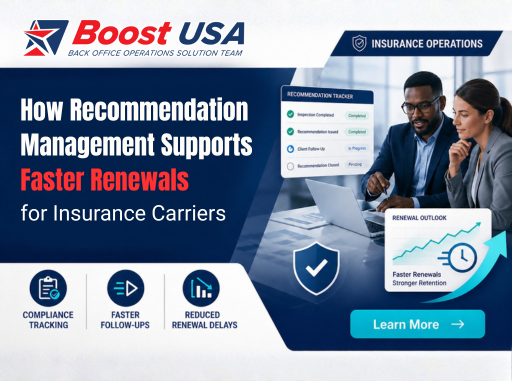
Renewal season does not start 60 days before expiration. For underwriters who know what they are doing, it starts the moment the previous year’s inspection report lands on the desk. However, for most insurance carriers managing mid to large commercial books, the renewal conversation is still happening in the dark. Underwriters are asking whether last year’s hazards were fixed, and nobody has a clear answer. This is why recommendation management is important.
Why Recommendation Management Is Critical in the Insurance Renewal Process
Here is what the typical renewal process actually looks like inside many carrier operations:
An underwriter pulls a commercial account for renewal. There are three open loss control recommendations from the prior policy period: an unguarded rooftop HVAC unit, deteriorating electrical panels, and a slip-and-fall exposure in the loading area. The underwriter emails the loss control team. The loss control team checks a spreadsheet. Nobody knows if the policyholder ever responded.
That ambiguity delays the renewal decision, compresses the timeline, and forces the underwriter to either write the risk without full information or request a new inspection. This adds weeks to a process that should take only days.
According to the National Association of Insurance Commissioners, underwriting data quality is one of the most consistently cited operational challenges for commercial lines carriers. What contributes more than almost anything else to that data gap? Unresolved, undocumented recommendations sitting in email threads and spreadsheets at renewal time.
What Clean Recommendation Management Enables in Insurance Renewals
When recommendation management is properly structured, tracked from issuance through verified closure, and supported by documented evidence, automated follow-up, and exception reporting, it ceases to be a back-office function. It becomes an underwriting asset.
Here is the practical difference it makes at renewal:
Without Structured Recommendation Management | With Verified Recommendation Management |
Underwriters assume prior hazards may still exist | Decisions are based on confirmed, documented risk conditions |
Renewal files are incomplete at the 90-day mark | Closure records are audit-ready throughout the policy period |
Follow-up depends on individual memory | Automated 30 and 45-day reminders drive policyholder action |
Exception items discovered after deadlines pass | Exception reports surface overdue items proactively |
New inspections ordered because prior data is unreliable | Prior period data is trusted and usable at renewal |
The renewal cycle takes weeks longer than it should | Underwriters move faster with confidence |
That last row matters more than it looks. In commercial lines, a faster renewal cycle is not just an operational win; it is a retention play. Policyholders who receive renewal offers early are more likely to renew at higher rates. Carriers that move faster than competitors on mid-market commercial accounts win business that slower operations lose by default.
Real World Impact of Recommendation Management Gaps in Insurance Operations
A Midwest-based specialty carrier writing commercial habitational was struggling with renewal cycle times averaging 47 days across its mid-market book. After an internal review, the bottleneck was clear: loss control recommendations were being issued through the inspection workflow, but follow-up was scattered across territory managers’ inboxes, and there was no centralized record of what had been resolved versus what was still open.
At renewal, underwriters were starting from scratch on each account, essentially re-underwriting risks they had already reviewed the year before. When they centralized recommendation management into a single tracked system with automated reminders and documented closure verification, renewal cycle time dropped to under 30 days on the same book within two quarters. More importantly, underwriters reported greater confidence in the quality of their risk decisions.
The inspection data did not change. What changed was the ability to trust it.
How to Fix Recommendation Management Gaps in Insurance Workflows
Most insurance workflows are not broken at the inspection stage. They are broken in the 30 to 90 days that follow, in the space between identifying a hazard and confirming it has been fixed.
The fix is structural, not cultural. It requires:
Centralized intake: every recommendation entered in one system at the moment the inspection closes, not distributed across email threads
Risk-based prioritisation: high severity items on 30-day cycles, medium on 60, low on 90, so attention goes where it matters first
Automated escalation: when deadlines pass without policyholder response, the system escalates rather than waiting for a human to notice
Threaded documentation: photos, contractor invoices, and safety certificates logged directly against the recommendation they resolve
Verified closure: not self reported, but confirmed before any item is marked complete and handed to carrier underwriting
Without that last step, closed recommendations are not really closed. They are just unchallenged.
How Recommendation Management Improves Underwriting Confidence
Underwriters make better decisions when they trust the data they work with. When recommendation records are incomplete or unverifiable at renewal, underwriters compensate by adding risk loads, ordering redundant inspections, or moving more slowly. All of this adds cost and friction that do not need to exist.
Strong carrier underwriting teams are not just looking for inspection data. They are looking for inspection data they can stand behind in front of actuaries, carriers, and claims teams if a loss occurs.
Verified recommendation closure provides exactly that.
Ready to Improve Insurance Renewal Efficiency with Recommendation Management? Act Today!
If your team is heading into renewal season without clean, verified recommendation records, or if your underwriters are still making decisions based on assumptions rather than confirmed risk conditions, it is time to fix the workflow rather than repeat the same process.
Boost USA’s BoostRM platform centralizes every recommendation across your book, automates follow-up, tracks closure with verified documentation, and gives your underwriters the audit-ready records they need to move faster and make better decisions at renewal and every day in between. Schedule a free 30 minute portfolio review. Get in touch with us today!