Your team closes a demanding quarter. Inspections are complete, reports are filed, and recommendations are issued. On paper, everything appears organized and under control. Weeks later, you discover that a large portion of those recommendations are still open. No follow-ups were sent, no escalation was triggered, and no one noticed until the exposure had already grown.
For MGUs operating at scale, this is not a rare exception. It is one of the most costly breakdowns in the underwriting cycle. That is why recommendation management is so important.
When recommendation management is treated as an afterthought, the gap between issuing a recommendation and closing it becomes a major operational risk. Loss ratios erode, carrier trust weakens, and profitability quietly suffers.
The Hidden Cost of Manual Recommendation Tracking
MGUs are under constant pressure to balance underwriting performance with operational efficiency.
Unlike traditional carriers, many MGUs manage niche or specialty programs with lean teams and strict carrier expectations. Yet recommendation tracking in many organizations still depends on spreadsheets, email threads, and disconnected folders.
This approach breaks down quickly as portfolios grow. Follow-up reminders are missed, supporting documents become buried in inboxes, and unresolved recommendations remain open far longer than intended.
By the time a carrier audit or renewal review takes place, the lack of documented follow-through becomes impossible to ignore. Industry guidance from the International Risk Management Institute (IRMI) consistently highlights poor recommendation closure practices as a contributor to deteriorating loss ratios in commercial insurance programs. Carriers increasingly expect MGUs to demonstrate not only that recommendations were issued, but also that they were actively monitored, documented, and closed.
Why MGUs Need Automated Recommendation Management
Recommendation management is especially challenging for MGUs because they often oversee multiple specialty programs across different property types, regions, and risk classes. Each program may have its own inspection schedule, compliance timeline, and reporting requirements.
Three operational realities make manual tracking particularly risky.
1. Recommendation Volume Increases Faster Than Teams
As an MGU scales, the recommendation volume can grow rapidly. Without structured workflows, teams shift from proactive management to reactive triage. This increases the likelihood that high-priority hazards will be overlooked.
2. Compliance Timelines Are Strict
Many carrier agreements require recommendations to be addressed within 30 to 60 days. Missing those deadlines creates underwriting exposure, renewal friction, and potential claims risk.
3. Documentation Requirements Continue To Increase
Carriers now expect evidence such as invoices, inspection photos, and completion certificates. Managing that documentation manually across hundreds or thousands of recommendations is difficult and increases the risk of errors.
What Automated Recommendation Management Looks Like
Automated recommendation management replaces fragmented processes with a structured workflow that scales consistently across an entire portfolio.
A modern system typically includes:
- Centralized intake: Every recommendation is logged within a single platform, assigned a unique ID, linked to the policy, tagged by severity, and connected to compliance deadlines.
- Automated follow-ups: Reminder notices are sent automatically at scheduled intervals, such as 30 and 45 days, eliminating the need for manual outreach.
- Escalation triggers: High-risk unresolved items are flagged before they become carrier or claims issues.
- Document management: Photos, invoices, and corrective action records are attached directly to the recommendation file for easy retrieval.
- Formal closure tracking: Recommendations are closed with timestamps, reviewer approvals, and complete audit trails.
The difference between manual and automated workflows becomes clear over time. Manual systems are inconsistent and reactive, while automated systems create standardized processes that improve visibility, accountability, and compliance rates.
Why Recommendation Tracking Directly Impacts Risk
Not every recommendation carries the same level of urgency, but every unresolved recommendation carries consequences.
A missed roofing deficiency can lead to a major property claim. An unresolved fire suppression issue can become a carrier audit finding. A neglected contractor safety recommendation can evolve into litigation exposure.
Successful MGUs treat recommendations as active risk signals rather than administrative tasks. When those signals are ignored, the impact eventually appears in loss ratios, renewal negotiations, and carrier confidence.
How Automation Improves MGU Operations
The greatest advantage of automation is not simply speed. It is predictability.
Structured workflows ensure that every recommendation moves through the same process regardless of workload, staffing changes, or portfolio size. That consistency creates measurable operational value in three critical areas.
Stronger Carrier Relationships: MGUs with automated systems can provide real-time reporting and documented audit trails immediately when carriers request updates. That level of visibility demonstrates operational discipline and strengthens carrier trust.
Faster Renewals: Open recommendations slow down underwriting decisions during renewals. When corrective actions are consistently tracked and documented, renewals move faster because underwriters can evaluate cleaner and lower-risk files.
Scalable Growth: Manual tracking requires additional staff as recommendation volume increases. Automated workflows enable MGUs to scale portfolios without increasing administrative overhead at the same rate.
What MGUs Should Look For In A Recommendation Management Solution
Not every system delivers the same operational value. MGUs evaluating recommendation management platforms should prioritize the following capabilities:
- Real-time dashboard visibility
- Automated follow-up scheduling
- Centralized document storage
- Exception reporting for overdue items
- Scalable workflows capable of handling high recommendation volume
- Integration with existing underwriting and loss control systems
These capabilities transform recommendation management from a reactive administrative burden into a reliable operational framework.
How BoostRM Supports MGUs
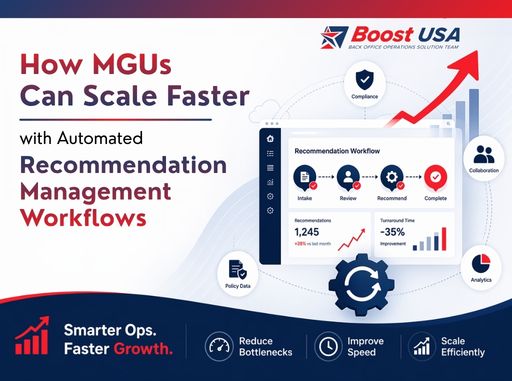
BoostRM™ from Boost USA was designed specifically to solve the follow-through gap MGUs often face. The platform manages the entire recommendation lifecycle, including intake, automated reminders, escalation workflows, document management, and formal closure tracking.
The system provides MGUs with centralized visibility into their recommendation portfolios while reducing the manual workload placed on underwriting and loss control teams. Automated notifications help ensure compliance timelines are consistently met, while exception reporting identifies high-risk items before they escalate into larger operational issues.
Most importantly, the platform is built to scale. Whether managing hundreds or thousands of recommendations, MGUs can maintain consistent processes without expanding administrative headcount.
Final Thoughts About Recommendation Management
Scaling an MGU requires more than underwriting expertise. It also requires operational discipline.
Recommendation management sits at the center of that discipline because it directly affects carrier confidence, compliance performance, loss ratios, and renewals.
Inspections may identify the risk, but follow-through determines whether the exposure is actually reduced. MGUs that implement structured and automated recommendation management systems are better positioned to scale efficiently, strengthen carrier relationships, and protect the long-term health of their programs.
Frequently Asked Questions About Recommendation Management
What Is Recommendation Management In Insurance Operations?
Recommendation management is the process of tracking, following up on, documenting, and closing risk recommendations issued during inspections or underwriting reviews. It ensures corrective actions are completed on time and properly recorded. For MGUs, it helps reduce exposure and maintain carrier compliance.
How Do Automated Recommendation Management Workflows Help MGUs Scale Faster?
Automation eliminates manual tasks such as follow-ups, reminders, and escalation tracking, enabling teams to manage higher recommendation volumes more efficiently. It improves consistency, reduces errors, and keeps workflows moving without adding operational overhead. This helps MGUs grow without increasing staff at the same rate.
What Challenges Do MGUs Face Without Structured Recommendation Management Systems?
Without a structured system, recommendations often get lost in spreadsheets, email chains, or disconnected workflows. Missed deadlines, poor documentation, and unresolved hazards create compliance gaps and increase underwriting risk. Over time, this can negatively affect carrier relationships and renewal performance.
How Can Technology Improve Recommendation Tracking And Compliance In Underwriting Workflows?
Technology centralizes recommendation data, automates reminders, tracks documentation, and creates audit-ready records in real time. It improves visibility across the portfolio and ensures high-risk items are escalated before becoming larger operational issues. The result is stronger compliance, faster resolution, and more efficient underwriting operations.
Do Not Let Risks Slip Through The Cracks
Every unresolved recommendation is a hidden exposure waiting to become a claims issue, compliance gap, or carrier concern. BoostRM™ gives MGUs the visibility, automation, and control needed to close recommendations faster, strengthen carrier confidence, and scale operations without increasing administrative burden.
Do not let manual tracking slow your growth. Build a smarter and fully automated recommendation management workflow today with Boost USA. Get in touch with our team today.