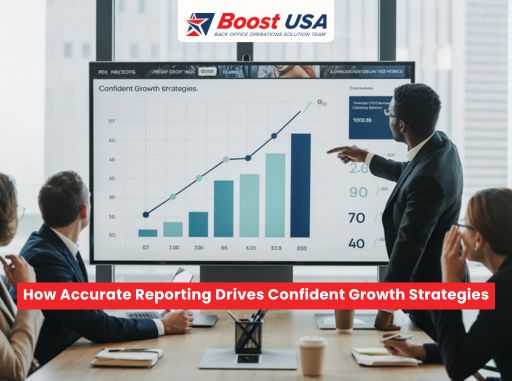
Growth decisions taken by businesses are only as strong as the data behind them. Though the best strategist can be hired, investment in the latest technology can be made, and an ambitious expansion plan can be built, if the reporting that feeds those decisions is flawed, incomplete, or delayed, confidence collapses at once. Accurate reporting is not a back office formality. It is the foundation on which sustainable, confident growth is built.
The Hidden Cost of Reporting Gaps in Business Operations
Most of the time, organizations do not realize that they have a reporting issue until something problematic shows up in the form of missed revenue targets, an underwriting decision made on outdated data, or a compliance gap that surfaces during an audit. By that point, the damage is already done.
It is important to note that poor data accuracy does not always announce itself. It leaks quietly through inconsistent records, manually entered figures that no one cross checks, and operational workflows where information passes through many hands before it reaches the decision maker.
Each handoff creates a chance for errors. Each error, no matter how small, distorts the picture that leaders rely on to grow. According to Harvard Business Review, poor data quality can cost organizations significantly in lost productivity and missed opportunities.
For insurance carriers, MGAs, risk management firms, and loss control companies, this challenge is especially consequential. Inspection data feeds underwriting. Underwriting feeds pricing. Pricing feeds profitability. When any link in that chain carries inaccurate information, there is a ripple effect that quietly erodes margins for months before anyone traces it back to the source.
What Accurate Reporting Enables for Business Growth
Accurate reporting transforms business intelligence from a passive record keeping function into an active growth tool. When your data is clean, timely, and consistently structured, several things become possible that would not be possible without it.
Strategic Business Decisions Become Faster
Leaders stop waiting for clarification, repeated data pulls, or manual corrections before acting. They trust the numbers in front of them because those numbers have a track record of being correct.
Forecasting Becomes More Reliable
Growth projections built on accurate historical data are not guesses presented in spreadsheets. They reflect genuine patterns, seasonal shifts, capacity trends, and revenue cycles, allowing teams to plan with precision instead of hope. Insights from McKinsey highlight how data driven organizations significantly outperform peers in decision making and forecasting accuracy.
Operational Inefficiencies Surface Quickly
When reporting is consistent and structured, anomalies stand out. A sudden drop in inspection completion rates, a spike in administrative processing time, or a mismatch between billed and collected revenue. These issues become visible before they become expensive.
Client and Partner Confidence Grows
Organizations that can report clearly and accurately project competence. This matters enormously in industries where trust is a differentiator and where the ability to produce clean, auditable records signals operational maturity.
Why Reporting Must Be Treated as a Strategic Business Function
The mistake many organizations make is treating reporting as something that happens after the real work is done. In reality, structured and accurate reporting is part of the real work. It belongs within the operational design of a business, not added at the end of a quarter.
This is where back office infrastructure becomes a genuine competitive advantage. When administrative workflows are built to capture data at the point of activity rather than reconstructed later from memory or fragmented files, accuracy improves significantly. Scheduling records, inspection outcomes, compliance tracking, revenue operations data, and financial transaction logs become more reliable when the systems and processes that generate them are designed with reporting in mind.
Business intelligence tools are only as powerful as the inputs they receive. An organization can invest in sophisticated dashboards and analytics platforms, but if the underlying data is inconsistent, incomplete, or isolated across disconnected systems, those tools will produce unreliable conclusions.
Building the Right Structure for Accurate Reporting and Growth
Confidence does not come only from bold predictions. It comes from building the operational infrastructure that enables accurate reporting at scale and then using that reporting to inform every decision that matters.
This means creating workflows that capture data consistently. It also means building quality assurance into reporting processes so that errors can be identified before they spread.
It also means integrating operational systems so that information flows without manual re entry, reducing both delays and the risk of transcription errors. It also means assigning clear ownership of reporting accuracy so that someone is always accountable for data integrity.
Organizations should treat reporting as a strategic priority and not as an administrative afterthought. It helps make better and faster decisions. It allows organizations to identify problems, capitalize on opportunities confidently, and scale without costly corrections.
It is important to note that growth without accurate reporting is like navigation without a compass. You may move quickly without being sure where you are heading. What you need to do is build a reporting infrastructure first, and then your growth strategies will be grounded in something more valuable than optimism: verifiable and reliable truth.
Final Thoughts: Build Your Growth on Truth, Not Assumptions!
At the end of the day, growth is not just about moving fast; it is about moving in the right direction. Accurate reporting turns uncertainty into clarity, hesitation into action, and ambition into measurable progress. It gives leaders something far more powerful than optimism. It gives them certainty. Because when your data is right, your direction is right. In a world where every decision compounds, that difference is everything.
Frequently Asked Questions About Accurate Reporting
Why is accurate reporting critical for business growth strategies?
Accurate reporting ensures growth decisions are based on reliable data, not assumptions. It helps identify real opportunities, avoid costly mistakes, and scale with confidence. Without it, even strong strategies can fail due to flawed insights.
How does accurate reporting impact decision making and forecasting?
It enables faster, more confident decisions by allowing leaders to trust the data in front of them. Forecasting becomes more precise, reflecting real trends instead of guesswork. This leads to better planning, budgeting, and resource allocation.
What are the common challenges in maintaining reporting accuracy?
Common issues include manual data entry errors, inconsistent data formats, disconnected systems, and insufficient quality checks. Multiple handoffs and delayed updates also increase the risk of inaccuracies. Over time, these small gaps create major reporting issues.
How can organizations improve the accuracy of their reporting processes?
Organizations can automate data capture, integrate systems to reduce manual work, and implement regular quality checks. Standardizing processes and assigning clear ownership for data accuracy also helps. Investing in the right tools and workflows ensures consistent and reliable reporting.
Build With Confidence and Grow With Precision!
If your growth strategy is only as strong as your data, then it is time to strengthen the foundation. Boost USA empowers insurance carriers, MGAs, loss control firms, and risk management organizations to build reliable back office systems, eliminate reporting gaps, and unlock data they can trust.