A single flawed loss control report does not just slow down underwriting; it can also delay payments. It distorts risk assessments, misguides decisions, and quietly erodes profitability. Yet across the insurance industry, report quality remains one of the most overlooked vulnerabilities in the entire underwriting chain. Insurance carriers invest heavily in scaling inspections. They expand inspector networks, deploy field technology, and push for faster turnaround times. But the quality assurance systems behind those reports often lag far behind. These reports rely on rushed desk reviews, basic checklists, and a lot of hope.
When inspection volume grows faster than quality control, inconsistency becomes inevitable. Inconsistency in risk data is one of the most expensive problems an underwriting organization can face.
Why Loss Control Report Quality Is a Business-Critical Issue
Loss control is the intelligence layer of insurance operations. When done well, it tells underwriters what they are insuring the real risks, real conditions, and real exposures before a policy is written and a claim is filed. When that intelligence is accurate, pricing is sharper, selection is smarter, and loss ratios are under control. When it is not, the consequences compound quietly.
There is a direct logic behind it: insurers who receive inconsistent, incomplete, or delayed loss control reports cannot make underwriting decisions with reliable data. Unlike a bad spreadsheet that can be corrected, a mispriced policy or a missed hazard often reveals itself only when the loss has already occurred. In short, building a scalable quality assurance program is not a process improvement project. It is a profitability strategy.
The Four Failure Points That Destroy Report Quality at Scale
Before you can build a QA program that scales, you need to understand where most loss control programs fail.
- Inconsistent Inspector Standards
When different inspectors apply different levels of scrutiny, your reports reflect their individual habits more than actual site conditions. One inspector flags a worn electrical panel; another notes it as “serviceable.” Both technically describe the same risk, but neither carries the same underwriting weight. - No Feedback Loop
Most QA reviews happen after a report is filed, often after an underwriting decision has been made. When errors surface only at that stage, they correct nothing. They create rework, delays, and inspector bad habits that go formally unaddressed. - Volume-Driven Shortcuts
As inspection volume scales, review time per report compresses. Reviewers begin prioritizing speed over depth. Pattern recognition fades. Subtle omissions such as missing photographs, vague recommendations, or unverified occupancy slips—slip through because there is simply no capacity to catch them systematically. - Platform Fragmentation
Teams managing loss control operations across multiple systems, such as LC360, often find that data lives in silos: images in one place, notes in another, and reports in a third. This fragmentation makes a comprehensive review structurally difficult, regardless of the reviewer’s skill.
What a Scalable Loss Control QA Program Actually Looks Like
A QA program built to scale does not rely on individual reviewers working harder. It relies on structured processes that make quality the default output rather than the exception.
Layer One: Standardized Review Criteria
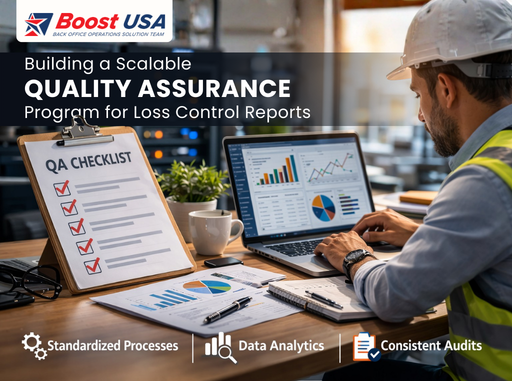
Every report should be evaluated against the same carrier-specific standards and regulatory requirements every time. This means documented checklists tied to property type, occupancy class, and inspection scope. Not judgment calls. Not memory. A defined standard produces consistent judgment at scale and forms the foundation for effective loss-control QA.
Layer Two: Pre-Submission Quality Checks:
The most powerful QA intervention happens before a report leaves the field. Automated flags for missing photographs, incomplete sections, or mismatched data catch the majority of deficiencies at the source, when they are fastest and cheapest to fix. This single structural shift can reduce downstream rework by more than half.
Layer Three: Real-Time Inspector Feedback
When a deficiency is caught, feedback needs to reach the inspector immediately, not in a monthly performance review. Real-time correction builds inspector capability over time rather than simply cataloging failures. This turns QA from an audit function into a training engine, which is exactly what inspection quality assurance should deliver at scale.
Layer Four: Dedicated Administrative Support
Quality reviewers can only do quality work when they are not simultaneously managing scheduling, rerouting assignments, chasing missing documentation, and updating carrier systems. A dedicated administrative layer that handles the full operational workflow around inspections frees review capacity for work that actually requires expertise.
Layer Five: Trend Reporting and Root Cause Analysis
A QA program without data analytics is pattern-blind. Tracking deficiency types by inspector, region, property class, and time period reveals where systemic issues exist. This intelligence layer turns quality review from reactive correction into proactive program improvement, separating a true underwriting report QA function from a mere compliance checkbox.
How Boost USA Powers Loss Control QA Operations
This is precisely the operational architecture Boost USA delivers for insurance carriers, managing general agencies (MGAs), and loss control firms across the country. Our loss control support services include multi-layer quality assurance protocols aligned with carrier-specific standards, 24/7 administrative support to eliminate operational bottlenecks, seamless integration with platforms like LC360, real-time deficiency feedback systems, and territory management that matches inspector expertise to inspection type.
Backed by SOC 2 and ISO 27001 certifications, every report that moves through Boost USA’s workflow meets the compliance and security standards the industry demands.
The result is not an incremental improvement. Carriers working with Boost USA see inspection turnaround times drop by 40–50% and quality-defect rates fall by 60–70%, not because reviewers work harder, but because the program itself is built to produce quality at scale.
The Competitive Advantage No One Talks About
Loss control quality is one of the few areas in insurance operations where process excellence creates an underwriting advantage. Better loss control reports enable better risk selection. Better risk selection means fewer surprises in the claims queue. Fewer surprises lead to a loss ratio that holds even when markets shift.
Carriers building scalable, structured loss control QA programs today are not just managing risks more effectively. They are building a data asset that compounds over time, sharpening their underwriting edge with every inspection cycle. The question is not whether your current loss control program produces quality reports; it is whether your QA infrastructure is built to guarantee that quality as your volume grows.
Final Thoughts
Loss control reports shape the decisions that shape your book of business. When their quality slips, underwriting accuracy follows, and the cost often surfaces only when a claim arrives. A scalable quality assurance program closes that gap. It turns inspections into reliable risk intelligence rather than uncertain inputs.
Insurers that treat loss control QA as a strategic capability, not a back-office task, gain a powerful advantage: clearer risk visibility, stronger underwriting decisions, and a measurable edge in profitability.
FAQs
- Why is quality assurance important in loss control reports?
It ensures reports are accurate, consistent, and reliable, enabling underwriters to make informed decisions and prevent mispriced policies or overlooked hazards. - How can insurers build a scalable quality assurance process for loss control operations?
By implementing standardized review criteria, pre-submission checks, real-time inspector feedback, administrative support, and trend reporting, to ensure quality is maintained as inspection volume grows. - What common errors can quality assurance programs prevent in loss control reports?
Inconsistent inspection standards, missing or incomplete data, overlooked hazards, vague recommendations, and errors caused by rushed reviews or fragmented platforms. - How does a strong QA program improve loss control inspection accuracy and risk management?
It creates consistent, accurate reports that highlight real risks, enabling better underwriting decisions, smarter risk selection, and a measurable reduction in losses.
Turn Loss Control Into a Strategic Advantage
If your inspection volume is growing but your quality assurance process hasn’t kept pace, the risk to underwriting accuracy increases with every report. Partnering with the right operational support team can change that.
Boost USA helps insurance carriers, MGAs, and loss control firms scale inspections without sacrificing quality through structured QA workflows, administrative support, territory management, and integrated loss control systems.